
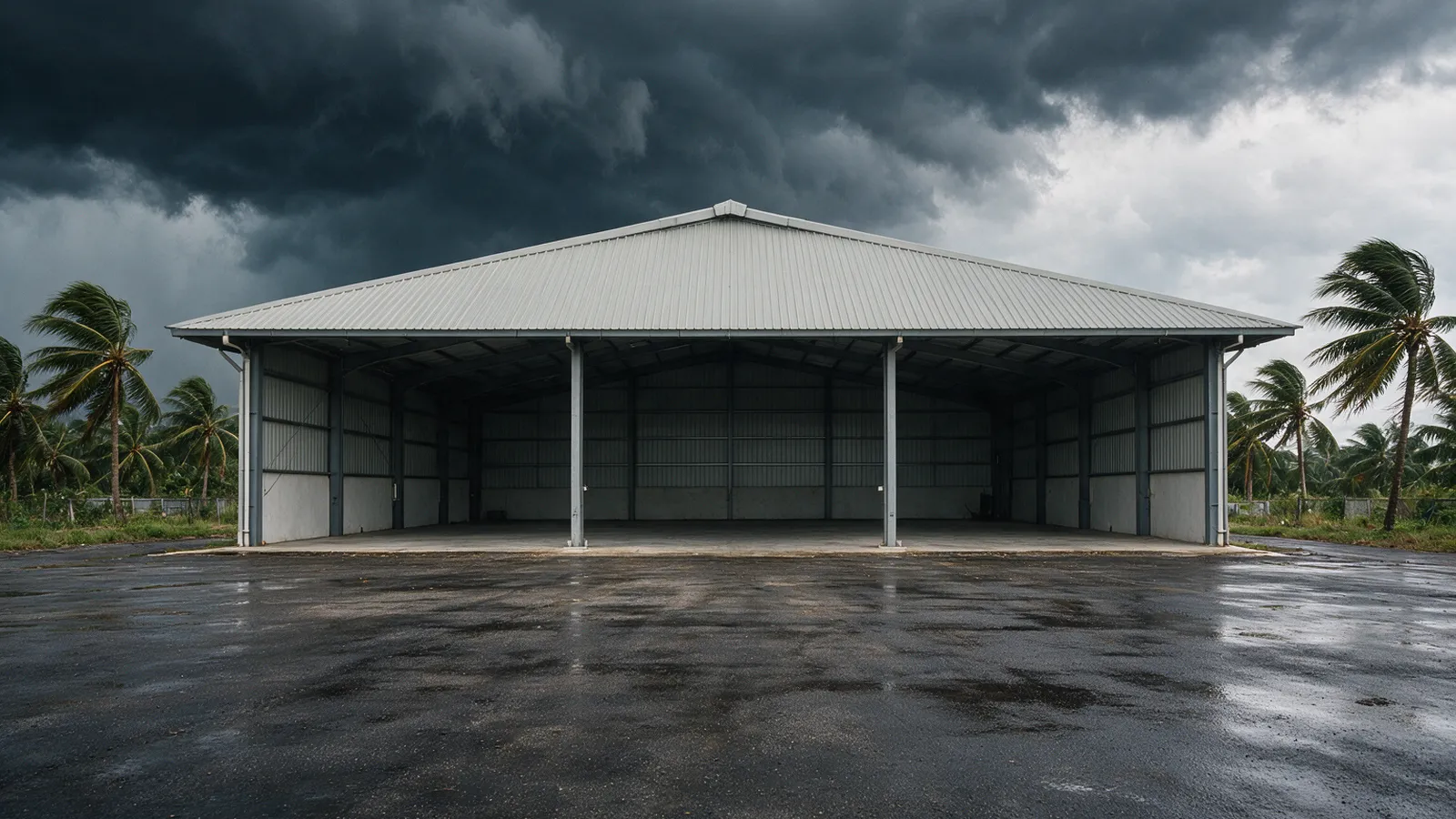
Key takeaways
- Generally, wind pulls a metal roof outward harder than it pushes it in, and the roof's light weight does almost nothing to resist that pull.
- The outward pull is resisted by the fixings: fasteners into battens or purlins, and framing fixed to the walls and, in extreme conditions, anchored to the footings.
- Lysaght's fastener-layout guide for its own pierce-fixed profiles gives the most common practice as 3 fasteners per sheet per support on internal spans and 5 on single and end spans; the wind design for a site sets the actual number.
- Sumatra squalls bring wind gusts of 40-80 km/h to Peninsular Malaysia for one to two hours, at night or in the morning, most often between April and November.
- In Malaysia, the wind load a roof must resist is worked out to MS 1553:2002, the code of practice on wind loading for building structures.
On this page9 sections
Why do metal roofs blow off in Malaysian storms?
A metal roof blows off when the wind's outward pull beats one link in its fixing. Wind sucks upward on the outside of a roof and, when air gets in through an open door, pushes up from inside, and a light roof has almost no weight to set against those forces.
The installation manual for Lysaght roofing explains the mechanism plainly:
"Generally the greatest wind forces imposed on roofs are due to the outward forces. Because the dead weight of roofing materials is relatively small, the outward forces must be resisted by the roof fasteners."
The same section names the two sources of that outward force: "uplift from negative wind pressures, outside the building; and ... positive wind pressure inside the building." For a factory or warehouse, a large roller shutter left open in a storm lets wind pressurise the building from inside while the roof is already being pulled from above.
Where does a metal roof come loose?
A metal roof comes loose at whichever link in its fixing is weakest. That can be a missing, loose or rusted fastener, a sheet end or overhang, a side-lap between two sheets, or a connection in the framing under the sheets. Because the roof's own weight does not hold it down, a single weak point is enough for the wind to start lifting a sheet.
The fixing pattern matters. In its fastener-layout guide for its own pierce-fixed profiles, Lysaght's manual gives the most common practice as 3 fasteners per sheet per support for internal spans and 5 for single and end spans, and it adds that side-lap fasteners are often placed at about 900 mm centres. A roof fixed with fewer fasteners than its manufacturer's documentation calls for has less to hold it down everywhere.
| Part of the roof | What to look at |
|---|---|
| Sheet fasteners | Missing, loose or rusted screws |
| Sheet ends and overhangs | Lifted or bent sheet ends |
| Side-laps | Gaps opening between sheets |
| Ridge capping and flashings | Capping or flashing that has moved |
| Battens, purlins and trusses | How each is fixed to the next |
Overhangs need care for a different reason. Lysaght's manual lists a maximum overhang for each profile, based on a nominal incidental load at the free edge, and advises stiffening or support where an overhang exceeds it. That limit is about accidental loading, not wind, but a sheet stretched past it to cover a walkway or loading bay is still a long, lightly held edge in a storm.
What kind of wind does a Malaysian roof have to survive?
Sumatra squalls, lines of thunderstorms that cross the Straits of Malacca from Sumatra, bring heavy rain and wind gusts of 40-80 km/h to Peninsular Malaysia for one to two hours, usually at night or in the morning. According to the Wikipedia record of Sumatra squalls, they can occur at any time of year but are most common from April to November.
These storms damage roofs. On 17 September 2018 a Sumatra squall struck Perlis, killing four people and damaging 56 houses and 36 schools, according to the same record. Local storms do the same: Utusan Malaysia reported on 6 March 2025 that a morning storm in Kampung Parit 4, Sekinchan, Sabak Bernam destroyed eight houses involving 36 victims; one family found the roofs over their kitchen and front section gone, and the owner estimated his losses at about RM120,000.
Which standard sets the wind load on a Malaysian roof?
In Malaysia, the wind load on a roof is worked out to MS 1553:2002, the Code of Practice on Wind Loading for Building Structure. The standard sets out procedures for determining wind speeds and the resulting wind actions to be used in structural design. An engineer uses it to find the load a particular roof must resist; the sheet, fastener and framing choices then follow from that number.
That is why no single wind speed or fixing pattern suits every roof: the design load depends on where and how the building stands, and a fixing pattern copied from another job is not a design. Product data is tested separately. Lysaght's manual states that its roofing profiles satisfy AS 1562.1, the Australian standard for sheet metal roof cladding, "including the ability of the roof to resist outward forces", with testing to AS 4040. The manual covers areas where tropical cyclones are unlikely and, outside Australia, refers to the equivalent local standard.
Our guide to purlin and batten spacing for a metal roof explains how the published support spacing is chosen, and choosing the metal deck profile covers the sheet itself.
Which connections hold a metal roof down?
A metal roof is held down by a chain of connections, and it is only as strong as the weakest one: the sheet to its fasteners, the fasteners into the battens or purlins, the battens and framing to the rafters and walls, and, under extreme conditions, the wall framing to the footings.
Lysaght's manual makes the same point about the structure below the sheet: "It is very important that the battens and roof framing are adequately fixed to the rafters and walls, and that under extreme conditions the wall framing is anchored to the footings."
- Sheet to fastener. The number and position of fasteners the sheet manufacturer specifies for the site, with side-lap fasteners where the documentation calls for them.
- Fastener setting. Fasteners with sealing washers are tightened only until the washer is gripped firmly; the manual warns that over-tightening may split the washer or deform the sheet.
- Battens and roof framing to the rafters and walls. Adequately fixed, as the manual puts it, because every load on the sheets ends up here.
- Wall framing to the footings. Anchored under extreme conditions, so the whole structure cannot lift.
A steel roof truss system is part of this chain, and how its trusses are fixed to the walls belongs in the same design conversation as the sheets.
What should you check on an existing metal roof?
On an existing metal roof, check the fixings before the squall season rather than after the first storm. From the ground or a safe access point, look for lifted or bent sheet ends, loose, missing or rusted screws, ridge capping or flashings that have moved, and gaps opening at side-laps. Each of these is a weak link in the chain that holds the roof down.
- After a storm, look inside for new leaks along laps and screw lines, and have any you find checked.
- Before extending an overhang or adding a canopy, check the manufacturer's maximum overhang for the profile instead of simply fixing a longer sheet.
- Before adding solar panels, see our checks for solar mounting on a metal roof.
- If many fasteners have rusted or the sheets are thin and pitted, read whether to repair, reroof or replace a metal roof before patching.
If a storm has already taken part of the roof, keep people out from under the damaged area, photograph the damage from the ground, and have the fixings and framing connections inspected before new sheets go on. Never walk on a storm-damaged roof to inspect it: a contractor with proper access equipment should do the close inspection.
How can Ducero help with a metal roof?
Ducero works on metal deck roofing, reroofing, cladding and light-gauge steel truss projects, and on mild-steel portal frame factory projects, offering design, supply and install solutions for the structure a roof sits on. Its project archive, as published, lists 479 entries. For a new roof, or for reroofing or roof covering after storm damage, send Ducero your drawings or photographs, the building's location and its roof dimensions.
You can reach Ducero through the contact page or by phone on +603 3123 1348. For work on a building that stays in use, our guide to reroofing an occupied building explains how the work is sequenced.
Frequently asked questions
Why do metal roofs blow off in storms?
Because wind generally pulls a roof outward more than it pushes it in, and a metal roof is too light to hold itself down. Lysaght's installation manual says the outward forces must be resisted by the roof fasteners, so when a fastener, batten or framing connection gives way, the sheet lifts from that point.
Where does a metal roof come loose in a storm?
At whichever link in its fixing is weakest: a missing, loose or rusted fastener, a sheet end or overhang, a side-lap, or a connection in the framing below the sheets.
How many screws should hold each roof sheet?
It depends on the profile and the design wind load, so the figure comes from the sheet manufacturer's documentation for the site. For pierce-fixed profiles, Lysaght's installation manual gives the most common practice as 3 fasteners per sheet per support for internal spans and 5 for single and end spans.
Which Malaysian standard covers wind on buildings?
MS 1553:2002, Code of Practice on Wind Loading for Building Structure. It sets out procedures for determining wind speeds and the resulting wind actions used in structural design. An engineer applies it to work out the wind load for a particular building and site.
What should I do after a storm damages my roof?
Keep people out from under the damaged area, photograph the damage from the ground, and do not climb onto the roof. Have the fixings and the framing connections inspected before new sheets go on, so the repair does not reinstate the same weak point.
How do I ask Ducero about a storm-damaged roof?
Ducero's work covers metal deck roofing, reroofing, cladding and light-gauge steel truss projects. For reroofing or roof covering after storm damage, send photographs of the damage, the building's location and its roof dimensions through the contact page at ducero.com.my/contact-us.php, or call +603 3123 1348.
Sources
- Lysaght, LYSAGHT Roofing & Walling Installation Manual, sections 2.3, 2.6, 2.7, 3.6, 3.7 and 3.8. An Australian manual for non-cyclonic areas; product data, not a Malaysian design code.
- Department of Standards Malaysia, MS 1553:2002 Code of Practice on Wind Loading for Building Structure (standard listing and scope).
- Wikipedia, Sumatra squall (timing, season, gusts of 40-80 km/h, the 17 September 2018 Perlis squall).
- Mohamad Athir Ismail, "Bumbung rumah hilang, dugaan Ramadan mangsa ribut", Utusan Malaysia, 6 March 2025.