
Key takeaways
- A metal roof repair, a reroof and a replacement renew different amounts: one defect, the whole covering, or the covering plus its supporting structure.
- For its own products, BlueScope Steel's bulletin TB-4 advises considering replacement of roofing fasteners that show red rust, because failing fasteners can corrode the sheet around them.
- Reroofing suits widely deteriorated sheeting on sound purlins and trusses; a doubtful structure needs an engineer before new sheets go on.
- The cost of metal roof work is driven by scope: area affected, access and safety measures, removal and disposal, renewed accessories and any structural work.
- A leak log, photographs, roof age, drawings and repair history make a site assessment faster and quotations easier to compare.
What is the difference between repairing, reroofing and replacing a metal roof?
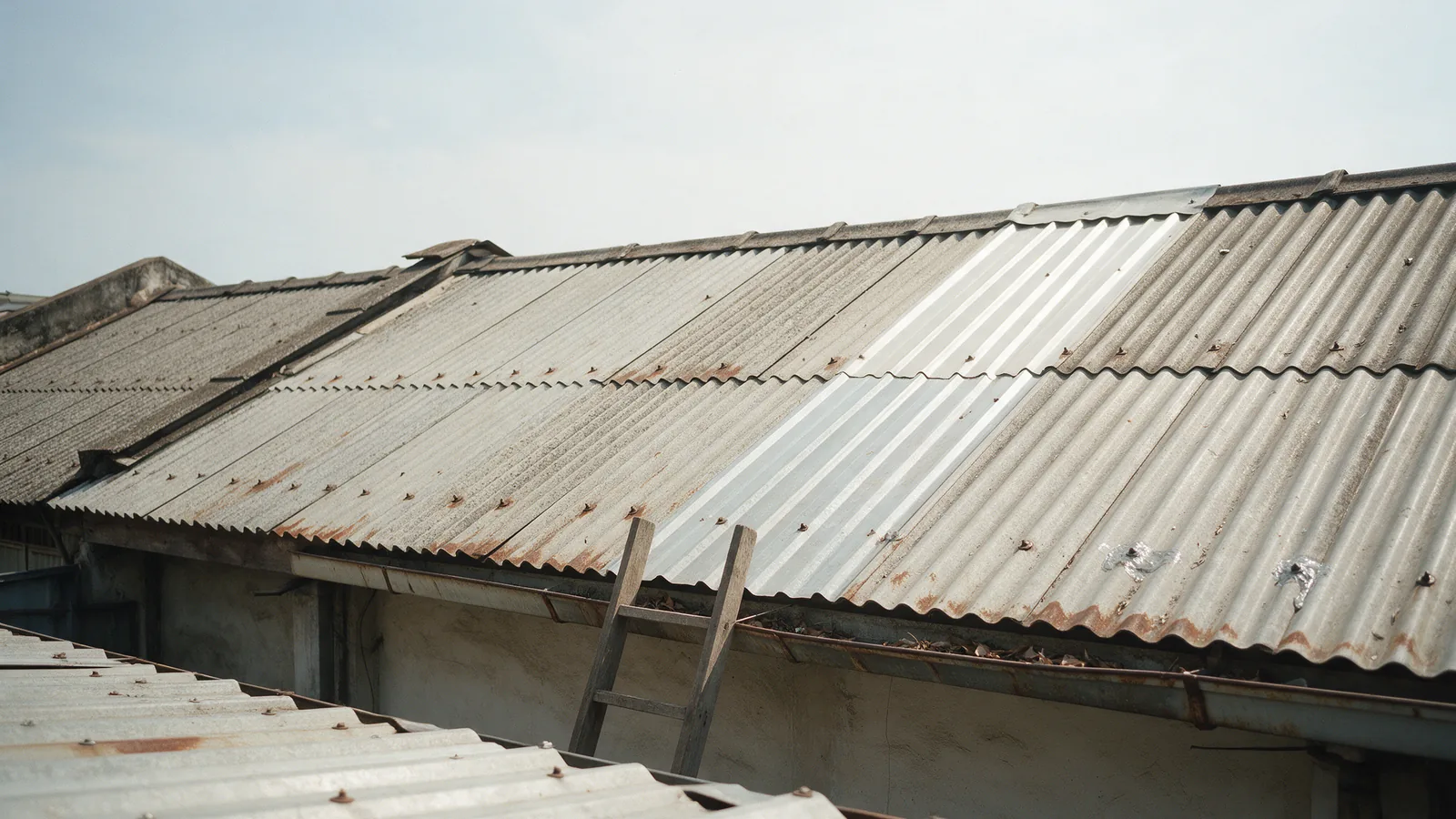
For a metal roof (often called a zinc roof in Malaysia), a repair fixes a defined, local fault such as a fastener, flashing or sealant joint. Reroofing removes and renews the roof covering, usually with its fasteners, flashings and insulation, while keeping the existing purlins and trusses. Replacement renews the roof system including the supporting structure. The deciding question is where the deterioration sits and how far it has spread, not the roof's age alone.
Contractors use these words loosely, so any quotation should write the scope out.
The condition of the purlins and trusses, rather than the sheeting, usually decides between reroofing and full replacement. New sheets fixed to corroded or deflected supports inherit their problems, while a sound structure lets reroofing correct what made the old roof fail. Our guide on choosing metal deck roofing for a Malaysian building covers profile and material selection once reroofing is confirmed.
Which metal roof leaks and defects can usually be repaired locally?
Local repair usually suits faults confined to one area of a metal roof: loose, over-tightened or rusting fasteners and washers, a lifted flashing, a failed sealant joint at a lap or penetration, a blocked gutter, small scratches and corrosion limited to a few sheets. A repair is sound only when the cause is also removed, for example by replacing fasteners with a compatible type.
Fasteners deserve the first look. BlueScope Steel's Australian maintenance bulletin puts it plainly:
“[R]apid deterioration of the fasteners used to fix BlueScope coated steel roofing or walling can result in sacrificial corrosion of the product in the areas immediately adjacent to the fasteners.”
TB-4 also recommends routine fastener inspection. A repair can create new corrosion if the wrong materials are used: BlueScope's fastener guide TB-16 requires fasteners for its roofing to meet at least AS 3566.2-2025 Class 3 and lists stainless steel, copper and copper-containing alloys as incompatible with its COLORBOND® and ZINCALUME® steel, and TB-13 recommends neutral-cure silicone sealants and warns that swarf left on a roof can cause localised corrosion. TB-2 says minor scratches under 2 mm wide and unnoticeable from ground level should be left alone, because the metallic coating protects the steel. These are BlueScope's recommendations for its products; other brands publish their own.
What signs mean a metal roof needs reroofing or full replacement?
Reroofing becomes the likely answer when corrosion, perforation or coating breakdown appears across many sheets, when leaks move around or return after competent repairs, or when water ponds on the sheeting. Full replacement enters the discussion when purlins or trusses are corroded, deformed, cut or overloaded, because new sheets cannot compensate for an unsound structure.
Ponding on a metal roof is a structural and design warning, not only a leak. BlueScope's bulletin TB-13 notes that supports must be carefully aligned to avoid low spots where ponding occurs, which ultimately reduces service life, and that minimum pitch has an important influence on the life expectancy of roofing and depends on the profile and fixing method. If the pitch is too low for the existing profile, new sheets of that profile will repeat the failure. Any sagging, corroded or modified truss is a question for a qualified engineer; our guide to steel roof truss systems in Malaysia explains what a truss replacement involves.
How do common metal roof symptoms map to a likely scope of work?
Most metal roof symptoms point towards one of three scopes: a local repair, a partial or full reroof, or structural work followed by a new roof. The table below is a starting point for discussion with a contractor, not a diagnosis.
| What the owner sees | Likely cause | Likely scope | Who should confirm |
|---|---|---|---|
| Repeatable drip or stain in one spot in heavy rain | Loose, over-tightened or rusting fastener; perished sealing washer | Local repair with compatible fasteners | Roofing contractor |
| Leak at a wall junction, ridge or around a pipe or vent | Failed flashing or sealant joint | Local repair of flashing and sealant | Roofing contractor |
| Fine scratches with no red rust | Handling or installation marks | Often no action (per BlueScope TB-2 for its products) | Contractor or manufacturer |
| Red rust at fasteners and laps across many sheets | Spreading corrosion of the covering | Partial or full reroofing | Contractor, with photographs |
| Leaks in new places after repeated repairs; holed sheets | Covering at end of useful life | Reroofing | Contractor |
| Ponding, sagging or wavy sheets | Misaligned or deflecting supports; pitch too low for profile | Structural check before reroofing | Qualified engineer |
| Corroded, deformed or cut purlins or trusses | Structural deterioration or alteration | Structural repair or replacement, then new roof | Qualified engineer |
A metal roof symptom that sits in two rows of the table deserves the more cautious scope until an inspection rules it out.
What affects the cost of repairing, reroofing or replacing a metal roof?
The cost of metal roof work depends on the scope confirmed on site, not on a standard rate, which is why this guide gives no ringgit figures. The main drivers are the roof area affected, access and working-at-height measures, removal and disposal of old sheets, which accessories are renewed, any purlin or truss work with engineering input, and whether the building below must stay in use.
- Area and extent. How much of the roof is affected, and whether work is local, partial or roof-wide.
- Access and safety. Edge protection, scaffold or lifting equipment, and covers for roof lights.
- Strip-out. Removing old sheets and fasteners and disposing of them.
- Accessories. Whether flashings, insulation, gutters and fasteners are renewed with the covering.
- Structure. Purlin or truss repair or replacement, and the engineer's design input.
- Programme. Phasing to keep the space below in use, and allowance for wet weather.
Metal roof quotations can only be compared fairly when each one itemises the same written scope. Ask each contractor to list these items separately.
Why do Malaysia's climate and a building's location change the answer?
Malaysia's humid, rainy climate means moisture is present on a metal roof for much of the year, and local conditions such as sea spray and industrial fallout affect how fast corrosion develops. Corrosion on parts of a building that rain does not wash, such as fascias, eave-gutter undersides and cladding under eaves, is often a maintenance gap rather than a sign that the whole roof covering has failed.
The Malaysian Meteorological Department describes the country's climate as having “uniform temperature, high humidity and copious rainfall”. Over most of Peninsular Malaysia, MetMalaysia reports a primary rainfall peak in October to November and a secondary peak in April to May, while the east coast states are wettest from November to January. MetMalaysia notes that the southwest coastal area is the exception, with October and November its wettest months.
BlueScope's TB-4 lists fascias, wall cladding under eaves and the underside of eave gutters among typical unwashed areas, where dirt builds up and can start corrosion, and recommends washing them at least six-monthly, or three-monthly in coastal, dusty or industrial locations. Keep a leak log through the wet months, when the best evidence appears, and plan any open-roof stage away from local peak rainfall.
Can a coating or overpaint be used instead of replacing a metal roof?
A coating can restore appearance and add some protection to a metal roof whose sheets are still sound, but it does not fix loose fasteners, failed laps, holed sheets or a weak structure. For BlueScope coated steel, the manufacturer's bulletin TB-2 states that overpainting voids any BlueScope warranties, so owners should check warranty status before choosing a coating over reroofing.
TB-2 confirms that COLORBOND® steel, ZINCALUME® steel and zinc-coated steel can be overpainted. BlueScope warns that air-drying paints weather differently from its oven-cured prepainted finishes, so overpainted areas may change in appearance over time, and it does not recommend touch-up paint for scratches. Compare a coating quote with a reroofing quote on the same basis: which defects each one actually removes. For other brands, ask the sheet manufacturer before coating.
What evidence should a building owner prepare before a roof assessment?
A building owner should prepare the roof's age, any drawings, a dated leak log, photographs taken from safe positions, the repair history and a note of anything added to the roof since it was built. This metal roof evidence pack helps a contractor separate local defects from roof-wide deterioration and makes quotations easier to compare.
- Roof age and documents. Year of completion, drawings, and any product name or warranty certificate for the sheeting.
- A leak log. Date, rain intensity, and where water appeared, marked on a floor plan, knowing the entry point may be upslope.
- Photographs from safe positions. Ceiling stains, the roof underside, gutters and outlets, taken from the floor, a window or a safe platform.
- Repair history. What was done, when, and with which sealants or screws.
- Changes to the roof. Added air-conditioning units, roof lights, extensions or solar panels. Our guide to solar mounting on a metal roof lists what should be checked when panels are involved.
- Site conditions. Distance to the sea, nearby industry and overhanging trees.
- Access and operations. Roof access points, known fragile areas, and whether the space below stays in use.
A dated leak log with photographs is the most useful single document an owner can bring to a metal roof assessment. Once the pack is ready, email the photographs and leak log to info@superdaya.com or call +603 3123 1348 (Monday to Friday, 9.00am to 5.00pm) to discuss whether the roof needs a repair, a reroof or structural work.
What roof-access safety rules apply before anyone inspects the roof?
Anyone going onto a metal roof is working at height, and corroded sheets and roof lights may not carry a person's weight. DOSH's working-at-heights guidance tells employers to avoid work at height where practical, check that a place such as a roof is safe before use, take precautions near fragile surfaces and plan rescue. Owners should gather evidence from the ground and leave the roof to competent, equipped workers.
The Department of Occupational Safety and Health (DOSH) notes that Malaysian regulations set the prescribed fall distance at 10 feet, while stressing that lower heights still need a risk assessment when other hazards exist. DOSH's guidance also tells employers to stop objects falling or mark off no-go zones below, and to plan for emergencies without relying solely on the fire department for rescue. It also refers readers to its Guidelines for the Prevention of Falls at Workplaces. Ask any contractor how they will reach the roof and protect edges, roof lights and people below.
Who should assess and carry out metal roof work, and where does Ducero fit?
A metal roof decision needs a contractor who can inspect the covering and details, and a qualified engineer whenever the purlins, trusses or loads are in question. In Malaysia, CIDB states that contractors must register with it under Section 25 of Act 520 before undertaking construction work, unless exempted, so ask for current registration and a written scope before work starts.
Structural questions, including loads, spans, fixings and wind, should always be answered by a qualified engineer using current manufacturer documentation for the products chosen.
Ducero Sdn Bhd, part of Superdaya Group, lists roof covering, metal-deck systems, reroofing, wall cladding, party-wall capping and strip ceiling work among its published work. The group supplies light-gauge steel roof trusses, and the roofing page lists 94 project archive entries from 2021 to 2025, most of them light-gauge steel truss work. Ducero's project archive includes “2 Units Reroofing – Mutiara Oriental Condominium, Petaling Jaya, Selangor” (2025) and “1 Unit LGST + Reroofing – Taman Seri Taming, Cheras, Selangor” (2024). See the Ducero roofing page and project archive and the Superspan steel page. To discuss an existing roof, email photographs and your leak log to info@superdaya.com, call +603 3123 1348 during office hours, or describe the roof on the Superdaya contact page.
Frequently asked questions
How can I tell whether a metal roof leak is only a loose screw?
A leak from one fastener often shows as a small, repeatable drip or stain in one place during heavy rain, but water can run along the sheet, purlins or insulation before it drips, so the fault may sit upslope of the stain. Leaks that move around or return after sealing suggest laps, flashings or spreading corrosion instead. A contractor can confirm on the roof.
Is repairing a metal roof always cheaper than replacing it?
A single local repair usually costs less than reroofing, but repeated repairs on a roof whose sheeting is deteriorating everywhere can end up costing more and still leave leaks. Compare quotations for the same written scope, using the cost drivers listed above, and ask each contractor to show with photographs whether the problem is local or roof-wide.
How long does a metal roof last in Malaysia?
No single figure applies to every metal roof: service life depends on the sheet product and its coating, the environment (BlueScope's TB-4 asks for more frequent washing in coastal, dusty or industrial locations), whether the pitch suits the profile and water drains without ponding (TB-13), fastener compatibility and maintenance. Judge an existing roof by its condition using the symptom table above, and ask the manufacturer for the service-life and warranty terms of the specific product.
Can new metal sheets be laid over an old metal roof?
Sometimes, but only after a qualified engineer has confirmed that the existing purlins and trusses can carry the extra load, that the new sheets can be fixed into sound structure, and that corrosion or trapped moisture underneath will not continue. The new sheet manufacturer's installation requirements also apply.
Can I paint a rusty metal roof instead of replacing it?
Only if the sheets are still sound and the rust is on the surface. Paint will not seal loose fasteners, failed laps or holed sheets, and it does nothing for corroded purlins, so those defects must be repaired first. Check the warranty position with the sheet manufacturer before coating, as explained in the coating section above.
When is the best time of year to reroof in Malaysia?
MetMalaysia reports that most of Peninsular Malaysia has rainfall peaks in October to November and April to May, the east coast is wettest from November to January, and the southwest coastal area peaks in October and November. Planning the open-roof stage away from local peak months reduces weather risk, though showers can occur year-round.
Sources
- BlueScope Steel — Technical Bulletin TB-4, Maintenance of exterior BlueScope coated steel products (Rev. 11, January 2021)
- BlueScope Steel — Technical Bulletin TB-2, Overpainting and restoration of exterior BlueScope coated steel products (Rev. 14, August 2022)
- BlueScope Steel — Technical Bulletin TB-13, General guide to good practice in the use of exterior BlueScope coated steel products (Rev. 11, August 2025)
- BlueScope Steel — Technical Bulletin TB-16, Fasteners for roofing, walling and accessory products (Rev. 15, June 2026)
- Malaysian Meteorological Department (MetMalaysia) — Malaysia's Climate
- Department of Occupational Safety and Health (DOSH) — Working at Heights
- CIDB Malaysia — Contractor Registration