Key takeaways
- A Solar ATAP application in Peninsular Malaysia must include an endorsed civil and structural drawing for the solar PV installation, so the roof's structural check has to be done before installation.
- One current module, JinkoSolar's Tiger Neo JKM580-605N-72HL4-(V), weighs 27.0 kg for 2,278 × 1,134 mm, about 10.5 kg per square metre before rails, clamps and brackets.
- BlueScope's compatibility table lists aluminium as suitable against COLORBOND® steel, but not 300-series stainless steel, copper, brass, lead or carbon-black washers.
- BlueScope recommends washing the shaded roof under PV panels at least every three months in coastal or industrial areas.
- Structure, watertightness, material compatibility and wind are separate checks on a metal roof: passing one does not prove the others.
What must be checked before solar mounting is installed on a metal roof?
Four checks decide whether a metal roof is ready for solar mounting: the structural capacity of the sheets, purlins and trusses; watertightness around every fixing and penetration; compatibility of metals, washers and sealants with the roof coating; and the wind and exposure conditions at the site. Each needs its own evidence, and the ten-step checklist below turns them into actions.
A metal roof that passes a structural check can still leak or corrode if the mounting method or materials are wrong. The table is a planning aid; the project engineer and the solar mounting structure supplier set the requirements for a given roof.
| Check | What is being confirmed | Who normally confirms it | Evidence to ask for |
|---|---|---|---|
| Roof structure | Sheets, purlins, trusses and connections carry array weight, bracket loads and wind uplift | Professional engineer | Structural assessment; endorsed civil and structural drawing |
| Roof condition | Sheets and fasteners are sound, with enough remaining life | Roofing contractor with the engineer | Condition report with photographs |
| Watertightness | Clamps or penetrations keep the roof sealed and drainage clear | Mounting designer and roofing contractor | Fixing details for the actual roof profile |
| Material compatibility | Nothing incompatible touches the roof coating | Mounting supplier | Material schedule, including washers and sealants |
| Wind and site | Fixing layout suits the site's wind speed, height, terrain and exposure | Professional engineer | Calculations stating the wind code and assumptions |
Can the existing roof structure carry a solar array?
Whether an existing metal roof can carry a solar array depends on its purlins, trusses, connections and sheets, not on how the roof looks from below. A professional engineer should check the added weight of panels and rails, the concentrated load at each bracket, maintenance foot traffic and wind uplift, then confirm the roof or specify strengthening before any bracket is fixed.
The panels themselves are a known quantity. According to its manufacturer's datasheet, JinkoSolar's Tiger Neo JKM580-605N-72HL4-(V) module weighs 27.0 kg and measures 2,278 × 1,134 × 30 mm, which works out at about 10.5 kg per square metre of module. Rails, clamps and brackets come on top, and the engineer should work from the actual bill of materials, not this indicative figure.
Brackets should transfer load into members the engineer has approved, not only into thin roof sheeting. On a new building, include the solar load in the roof design from the start; see how to choose a steel roof truss system in Malaysia.
How do you keep a metal roof watertight around solar mounts?
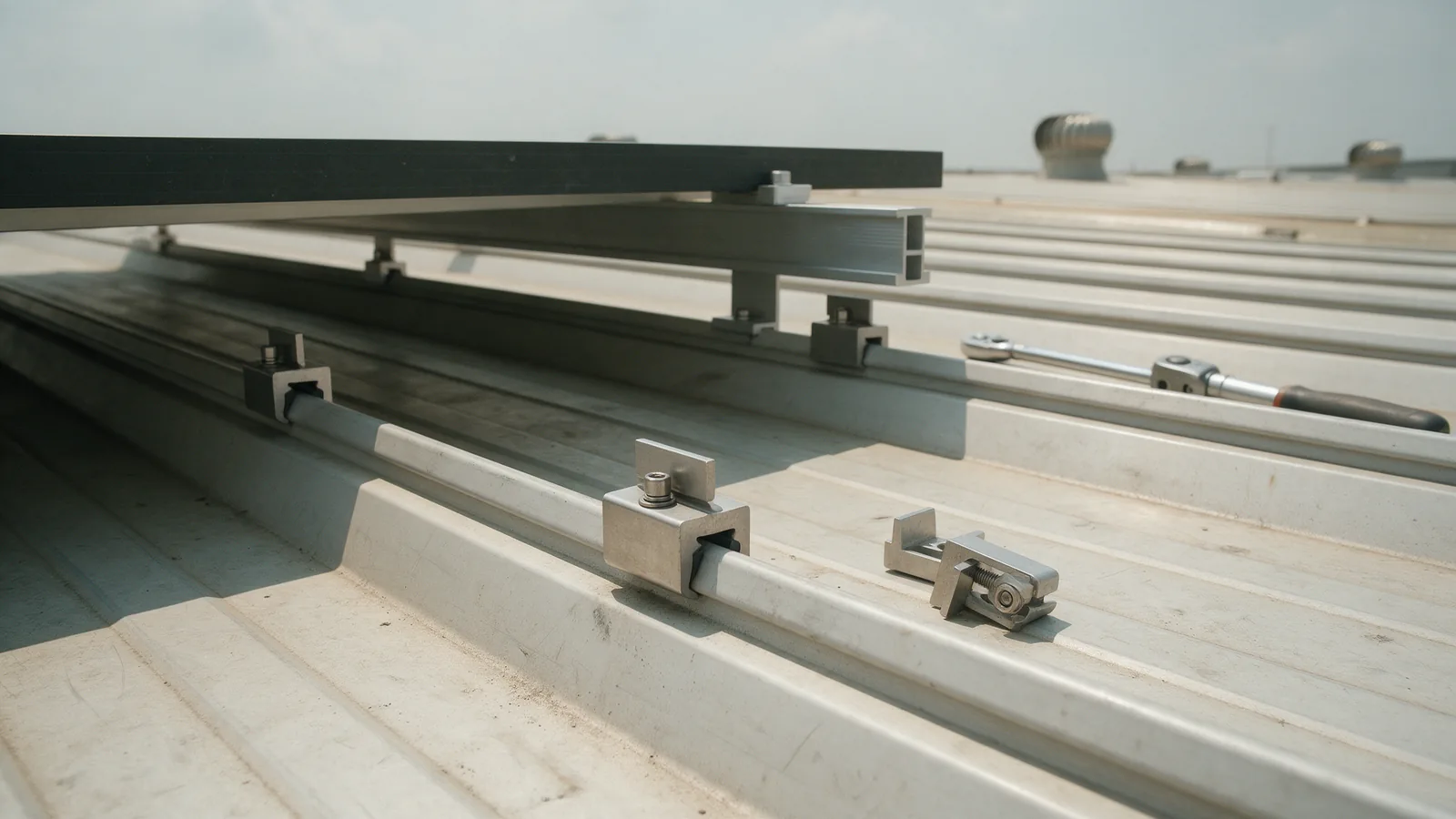
A metal roof stays watertight under solar mounting when fixings avoid the places water runs and laps seal, and every unavoidable penetration is properly flashed or sealed. The right detail depends on the profile: concealed-fix klip-lok or standing-seam sheets, trapezoidal metal deck, corrugated "zinc" roofs and insulated sandwich panels each need a mounting method designed for them.
BlueScope's Technical Bulletin TB-36 (revision 5, August 2025) sets out rules for its COLORBOND® and ZINCALUME® roofs: installations should allow free drainage and avoid ponding, and penetrations should be sealed with appropriate flashings and sleeves, and/or neutral-cure sealants. Keep fixings and cable holes out of the valleys, the bulletin adds, and brackets away from side laps, where they can distort the profile and let water in past the anti-capillary laps.
Clamp-on fixing is only possible on seam profiles designed for it; ask the sheet manufacturer whether the installed profile is rated for seam clamps. For how profiles differ, see how to choose metal deck roofing in Malaysia. Lysaght's installation manual also notes that length changes in very long runs of roofing are significant, so confirm that the mounting detail does not restrain that movement.
What about insulated or sandwich-panel metal roofs?
An insulated sandwich-panel roof has a thin outer steel skin over an insulation core, so solar brackets need the panel manufacturer's approved fixing detail and an engineer's confirmation that load reaches the purlins. Kingspan's KS1000 RW design and installation guide lists permanent installations such as solar panels among the loads that set a roof panel's span, alongside wind suction, and says these loads must be defined on each project by the designer. That is one manufacturer's guidance; follow the maker of the panel actually installed.
Which metals and materials can touch a coated steel roof?
Under BlueScope's compatibility table, aluminium and aluminium/zinc/magnesium alloy-coated steel accessories can be in direct contact with COLORBOND® and ZINCALUME® steel, and zinc-coated steel can too, with a caveat BlueScope explains in its CTB-25 bulletin on inert catchment. Stainless steel (300 series), copper, brass, lead, Monel and carbon-black materials should not touch these roofs, because galvanic corrosion can start at the contact point.
The table is Table 1 of BlueScope's Corrosion Technical Bulletin CTB-12 on dissimilar metals. The same bulletin describes stainless steel self-drilling screws, used incorrectly on COLORBOND® Ultra roof sheeting, leaving an area of corrosion approximately 40 mm in diameter around the screw head, and warns that carbon black in sealing washers is highly conductive; washers free of carbon black are readily available. These rules matter locally because NS BlueScope Malaysia states that its manufacturing facilities in Malaysia produce COLORBOND® and ZINCALUME® steel.
Runoff counts as contact: TB-36 advises against PV panels or flashings that use copper or lead, because their runoff can cause bi-metallic corrosion. BlueScope's TB-36 also says any sealant in contact with COLORBOND® or ZINCALUME® roofing should be neutral cure, and acetic acid-based sealants should be avoided. The PV system must be properly earthed, because stray currents to metal roof sheets may accelerate corrosion.
How do wind and site conditions change the mounting design?
Wind and site conditions change a solar mounting design because panels on a metal roof are pulled upward by wind suction and shaken by gusts, so the fixing layout must be calculated for that building. The engineer works from the site's design wind speed, building height, terrain and the array's position on the roof, then specifies brackets and fasteners that resist uplift and loosening.
A 2018 IOP Conference Series paper summarises the Malaysian Standard MS 1553:2002 wind code: its basic wind speed is 33.5 m/s for inland Peninsular Malaysia (Zone I) and 32.5 m/s for the on-shore outer perimeter (Zone II), measured at 10 m height for a 50-year return period. They are reference speeds, not roof design pressures; the engineer confirms which wind code and factors apply.
The US Department of Energy's Federal Energy Management Program lists common fastened-joint failures in PV systems, including vibration-induced loosening, joint relaxation and module mid-clamps that fail, "releasing an entire row of modules causing cascading failures". It recommends vibration-resistant fasteners on all critical fastened joints in a solar array.
Which approval route applies, and who must certify the structure?
Rooftop solar in Peninsular Malaysia usually follows one of two Energy Commission (Suruhanjaya Tenaga) routes: Solar ATAP, which lets consumers export surplus energy for credits, or self-consumption (SELCO), where the energy is used only on the premises. Both require the structural design of the solar installation to be certified by a qualified, competent person, so the roof checks apply either way.
What is Solar ATAP?
Solar ATAP, the Solar Accelerated Transition Action Programme, came into operation on 1 January 2026 under guidelines GP/ST/No. 60/2025. It lets consumers install solar PV for self-consumption, export surplus solar energy to the grid and receive credits based on the energy component only. The guidelines state:
"The design, calculation, drawings, installation, testing and commissioning of the solar PV installation ... shall be certified by a Competent Person as required under the relevant laws as follows: ... (b) the Registration of Engineers Act 1967 and the Architects Act 1967 in relation to the structure of mounting the PV panels."
Applicants appoint a Registered PV Service Provider from SEDA Malaysia's directory, and the application includes an endorsed civil and structural drawing.
What if the system is for self-consumption only?
Self-consumption systems follow the Energy Commission's Guidelines for Solar Photovoltaic Installation for Self-Consumption in Peninsular Malaysia (GP/ST/No.51/2024, revised June 2026). A grid-connected SELCO system may not export power at any time. Clause 5.6 requires structural drawings, among other documents, to be prepared and certified by a qualified and competent person under laws including the Registration of Engineers Act 1967, the Architects Act 1967 and the Uniform Building By-Laws 1984. Both guidelines cover Peninsular Malaysia; projects in Sabah and Sarawak should confirm their own state requirements. The rules above were checked on 22 September 2026.
What should a pre-installation checklist for a metal roof include?
A pre-installation checklist for solar mounting on a metal roof should record the roof's structure, condition, profile, materials and exposure before any design is priced, then capture the engineer's and installer's documents before work starts. The ten steps below follow that order, so problems surface while they are still cheap to fix and before brackets go through the sheets.
- Obtain roof drawings or a survey: sheet brand and profile, single-skin or insulated sandwich panel, pitch, purlin sizes and spacing, truss type and span direction.
- Commission a structural assessment by a professional engineer covering dead load, bracket point loads, maintenance access and wind uplift.
- Inspect the covering for rust, corroded fasteners, ponding dents, repairs and leaks, with dated photographs.
- Decide whether to repair, reroof or replace the roof before solar goes on.
- Confirm the mounting method suits the exact profile: seam clamps where the profile is rated for them, or pierce-fixed brackets with a sealing detail.
- Check that fixings stay out of valleys and away from side laps, and that drainage stays clear.
- Check the material schedule, including washers and sealants, against the roof sheet manufacturer's compatibility table.
- Ask for calculations stating the wind code, site assumptions and fastener specification, with vibration-resistant fasteners on critical joints.
- Plan clearance under the panels, cable routes off the roof surface, earthing and safe maintenance access.
- Confirm the approval route (Solar ATAP or SELCO) and collect the certified structural drawings before work begins.
Next step: to discuss mounting for a particular roof, send Superdaya the items from steps 1 and 3 (the roof drawings or survey, dated condition photographs, and the sheet brand and profile) at info@superdaya.com or +603 3123 1348, or through the contact page.
How should the roof under a solar array be maintained?
The roof under a solar array needs its own maintenance plan, because panels shade the sheets and stop rain from washing them clean. BlueScope classes these as unwashed areas with a higher risk of corrosion and recommends cleaning them with fresh water at least every three months in coastal or industrial areas and at least every six months elsewhere, with fastener inspections.
Design choices make that possible. The same bulletin recommends adequate clearance between panels and roof, commonly more than about 75 mm above the top of the rib, so debris clears itself, air dries the sheets and cleaners can reach the fasteners. Cables should not sit directly on the roof, where they trap dirt and salt; fix them to the PV support structure instead. Swarf from drilling and cutting should be removed daily during installation, and any corroded roofing fasteners that will sit beneath the panels replaced before they are covered.
Where does Sunrise Prima fit in a metal-roof solar project?
Sunrise Prima Sdn Bhd was established as Superdaya Group's solar arm in 2023 and provides engineered solar mounting structures for solar PV installations in Malaysia, in strategic collaboration with Solar Sentinel. The mounting structure is where this guide's checks on fixing method, materials and wind loads are settled.
Whichever supplier provides the mounting structure, ask three questions before ordering:
- Which roof profiles is the system designed for, and is the installed profile one of them? (checklist step 5)
- What is the full material schedule for rails, clamps, brackets, screws, washers and sealants? (step 7)
- Which wind code and fastener specification does the design use, and are critical joints fitted with vibration-resistant fasteners? (step 8)
Sunrise Prima's mounting structures are described on the group's solar mounting structures page.
Frequently asked questions
Do I need an engineer before installing solar panels on a metal roof?
Yes. Under Solar ATAP, the mounting structure must be certified by a Competent Person, and the Energy Commission's self-consumption (SELCO) guidelines likewise require structural drawings to be certified by a qualified and competent person. For any metal-roof array, an engineer's check of purlins, trusses and connections is sound practice.
Is a clamp-on system better than drilling through a metal roof?
A clamp-on system avoids piercing the roof sheet, which removes a common leak path, but it only suits seam profiles rated for clamps, such as some klip-lok or standing-seam roofs. Trapezoidal metal deck and corrugated sheets often need pierce-fixed brackets. Either method can work when the detail matches the exact profile, fixings avoid valleys and side laps, and the engineer confirms the load path.
Can stainless steel screws be used on a coated steel roof?
Not on COLORBOND® or ZINCALUME® steel, according to BlueScope, whose compatibility table marks 300-series stainless steel as unsuitable for direct contact with those roofs. Ask the mounting supplier to list every metal in the kit, including screws, clamps and washers, and to confirm that any sealing washers are free of carbon black.
Should an old metal roof be replaced before solar panels go on?
A leaking, rusted or badly dented metal roof is usually better repaired or replaced before solar goes on, because removing and refitting an array later adds cost and risk. BlueScope advises replacing corroded roofing fasteners that will sit beneath new panels and using PV fasteners and brackets with a service life comparable to the roof.
What is the difference between Solar ATAP and SELCO?
Solar ATAP lets a consumer in Peninsular Malaysia export surplus solar energy to the grid and receive credits based on the energy component, for a period of operation of up to ten years, after which the system may run strictly for self-consumption under the SELCO guidelines. SELCO covers systems strictly for self-consumption; a grid-connected SELCO system may not export power at any time. Both require certified structural design.
Sources
- Suruhanjaya Tenaga — Guidelines for Solar Accelerated Transition Action Programme in Peninsular Malaysia (GP/ST/No. 60/2025), December 2025
- Suruhanjaya Tenaga — Guidelines for Solar Photovoltaic Installation for Self-Consumption in Peninsular Malaysia (GP/ST/No.51/2024, Pin.1/2026), June 2026
- SEDA Malaysia — Registered PV Service Provider Directory
- BlueScope — Technical Bulletin TB-36, Guide to good practice: steel roofing and photovoltaic/solar panels (Revision 5, August 2025)
- BlueScope — Corrosion Technical Bulletin CTB-12, Dissimilar metals (Revision 6, October 2022)
- NS BlueScope Malaysia — About us
- Lysaght — Roofing and Walling Installation Manual
- Kingspan Insulated Panels — KS1000 RW Roof panel design and installation guide
- JinkoSolar — Tiger Neo JKM580-605N-72HL4-(V) module datasheet
- IOP Conference Series: Earth and Environmental Science 140 (2018) 012125 — Wind load effects on high rise buildings in Peninsular Malaysia
- US Department of Energy, FEMP — Severe Weather Resilience in Solar Photovoltaic System Design