Key takeaways
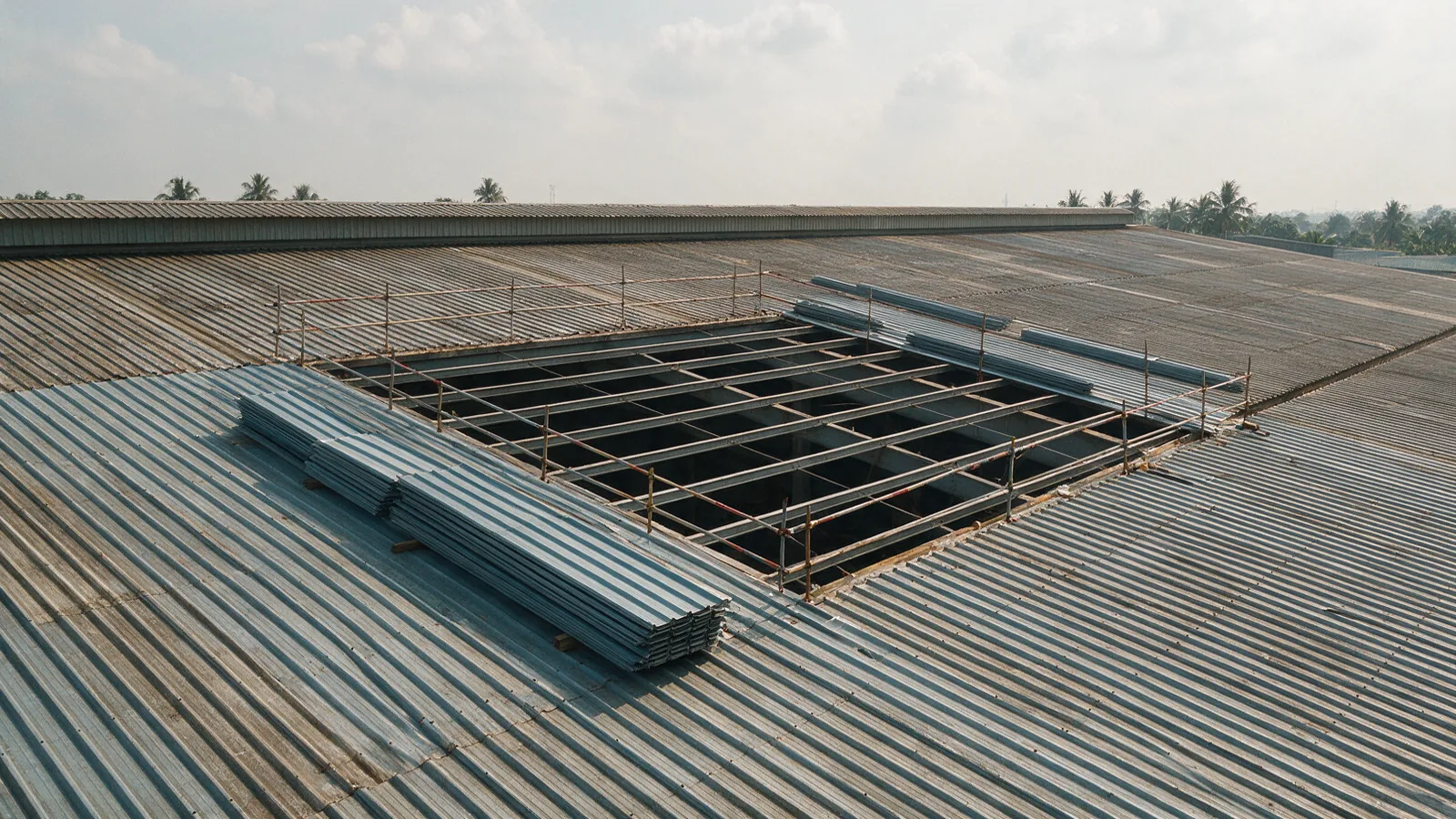
- The unit of work is a bay, not the roof. Only as much roof is opened as the crew can close again before it leaves site.
- Temporary weatherproofing is part of the scope, not a contingency. Decide who supplies it and who checks it at the end of each shift.
- Roof access is a safety-managed activity. The Department of Occupational Safety and Health says to check that the place, for example a roof, where work at height will be done is safe, and to take precautions when working near or on fragile surfaces.
- Protection below the roof is a separate line item from protection on it. Stock, machinery, ceilings, cabling and services each need a named owner.
- Ducero's published project archive lists roof covering and reroofing work alongside its light-gauge steel roof trusses. As listed on the company's own published archive, its listed jobs run from 2011 to 2025 and are concentrated in Selangor and Kuala Lumpur.
What does reroofing an occupied building involve?
Reroofing an occupied building means removing and replacing roof sheeting, and sometimes the supporting members, while the space underneath stays in use. The difference from an empty building is not the roofing work itself. It is that every hour of every day the building must still be weathertight, safe to stand under and, usually, still operating.
That single constraint reshapes the whole job. On an empty building a contractor can strip a large area and take a week to close it. On an occupied one the same crew works in bays, opening only what it can close again before it leaves. A reroofing programme that does not say how big a bay is, and what happens to it at the end of a shift, is not a programme for an occupied building.
This guide assumes the decision to reroof has already been made. If you are still weighing patch repairs against a full replacement, start with our guide on repairing, reroofing or replacing a metal roof and come back here once the scope is settled.
How should the work be sequenced so the building keeps operating?
Sequence the roof into bays sized by what the crew can strip, re-cover and seal within one working shift, allowing for rain stoppages. Each bay is finished before the next is opened. The sequence should also follow what is underneath, so the areas that matter most to the occupier are exposed for the shortest time and during the hours they are least in use.
Bay size is a planning decision, not a site decision. It depends on crew size, sheet length, access, the number of lifting operations per bay and how quickly the weather can turn. The useful question to ask a contractor is not "how long will the job take" but "how much roof will be open at 5pm on any given day, and what will you have done to it". A contractor who cannot answer that is treating the building as if it were empty.
Two practical sequencing rules are worth writing into the programme. First, the occupier nominates the areas that cannot be exposed at all during working hours, and those bays are done outside them. Second, the contractor nominates a stop point, the last moment in a shift at which a new bay may be opened. In practice, without a stop point an optimistic crew opens one more bay at four o'clock.
The bay cycle, step by step
- Open only as much roof as the crew can close again within the shift.
- Strip the sheeting and, where the scope includes it, the supporting members.
- Inspect what is exposed and report anything the enquiry did not anticipate before covering it again.
- Re-cover with the permanent sheeting where the programme allows, or fit the temporary weatherproofing where it does not.
- Seal laps, flashings and edges so the bay is watertight, not merely covered.
- Record the closed bay at the end of the shift, with a timestamped photograph.
What is temporary weatherproofing, and who is responsible for it?
Temporary weatherproofing is whatever keeps an opened bay watertight before its permanent covering is complete: sheeting, capping, taped laps, drainage diversions and the labour to fit them. It belongs in the scope of works with a named owner, a specification and an end-of-shift check. Treated as a contingency instead, it becomes an argument after the first storm.
Write the check into the programme: at the end of each shift a named person confirms every opened bay is closed and every temporary detail is fixed, and records it. A photograph with a timestamp is enough.
Drainage deserves its own line. During reroofing, water that used to run down a finished roof plane runs somewhere else. Agree where water goes during the works, not only when they are finished.
What has to be agreed before anyone goes on the roof?
Roof work is a safety-managed activity before it is a roofing activity. Agree who is competent to be on the roof, how they get there, how edges and openings are protected, how fragile areas are identified, and how the space below is closed off. The Department of Occupational Safety and Health says to check that the place, for example a roof, where work at height will be done is safe, to take precautions when working near or on fragile surfaces, and to stop objects or materials falling, for example by marking off no-go zones or using safety nets.
If practical, avoid working at heights.
That is the Department of Occupational Safety and Health's instruction on working at height, and on a reroofing job it is not available: the work is on the roof. What follows is that everything below that first line of defence has to be right.
On an occupied building there is a second hazard that an empty one does not have: people underneath. Anything dropped through an opened bay lands in a working space. Exclusion zones below the work are part of the safety plan, and in practice they need both parties: only the occupier can move the people and the stock.
Existing roof sheets on an older building should be treated as fragile until someone competent says otherwise. That assessment belongs before the programme is priced, because it changes access methods, crew sizes and therefore bay sizes.
What protection does the space under the roof need?
Everything under an opened bay needs a named protection method and a named owner: stock, machinery, finished ceilings, lighting, cabling, sprinklers and any service routed in the roof space. Protection below the roof is a separate item from protection on it.
The practical approach is a simple table agreed before work starts: what is under each bay, who moves or covers it, when, and who confirms it is back. The list should include anything sensitive to dust or debris as well as to water.
Services routed in the roof space need a decision before work starts: supported independently, temporarily isolated, or left untouched. That decision changes both the sequence and the price, so it belongs in the enquiry rather than in a site conversation.
Does the time of year change the programme?
It changes the risk, not the method. The Malaysian Meteorological Department describes the country's climate as having uniform temperature, high humidity and copious rainfall, and records that over most of Peninsular Malaysia the primary rainfall maximum generally occurs in October and November, with a secondary maximum in April and May, while over the east coast states November, December and January are the months with maximum rainfall.
A bay-based programme works in any month. What shifts with the season is how much contingency the programme should carry and how small the bays should be, because the cost of a bay left open is higher when rain is more likely.
What should the reroofing programme and contract state?
A reroofing contract for an occupied building should state bay size and sequence, the working hours available in each area, the temporary weatherproofing specification and its end-of-shift check, the roof-access and exclusion-zone arrangements, the protection schedule for what sits below, and what happens on a rained-off day. Those six items are what separate this contract from a roofing contract on an empty building.
The table below sets out what the programme should name and who commonly carries each item. The ownership column reflects common practice, not a legal position: the contract decides.
| Item | What it should state | Who usually owns it |
|---|---|---|
| Bay size and sequence | How much roof is opened at once and in what order | Roofing contractor, agreed with the occupier |
| Access windows | Which areas may be worked on, and when | Occupier |
| Temporary weatherproofing | Specification, who fits it, who checks it at end of shift | Roofing contractor |
| Roof access and edge protection | Method, competence, fragile-surface assessment | Contractor, under the occupier's site rules |
| Exclusion zones below | Which spaces are closed off while a bay is open | Occupier |
| Protection of contents and services | What is moved, covered or isolated, by whom | Split: name each line |
| Weather stoppages | What triggers a stop, and what is done to open bays | Roofing contractor |
What should you send when you ask for a reroofing quotation?
Send the building's roof drawings or a measured plan, photographs of the existing roof and its condition, the roof covering and any known structural type, the areas that cannot be exposed during working hours, the access available for materials and equipment, and any services fixed in the roof space. A quotation built from those is comparable; one built from an area figure alone is not.
If the existing roof structure is being replaced or added to rather than just re-covered, the enquiry also needs the loads the new roof will carry, including any future solar. Our guides on choosing a steel roof truss system and on solar mounting on metal roofs set out what the engineer will ask for. If the covering itself is being reselected, choosing metal deck roofing covers profile, coating and thickness.
Where does Ducero fit in a reroofing project?
Ducero supplies light-gauge steel roof trusses and undertakes roof covering and reroofing work. Its published project archive lists roof covering and reroofing among its job scopes alongside the trusses that make up most of it, with listed jobs running from 2011 to 2025 and concentrated in Selangor and Kuala Lumpur.
Every archive description above is as listed on the company's own published project archive, and each listed job is an individual scope of work rather than a blanket certification.
Every guide in this series is listed on our guides hub.
Frequently asked questions
Can a factory keep running while its roof is replaced?
Usually yes, if the work is sequenced in bays and the areas that cannot be exposed during working hours are named before the programme is priced. The constraint is not the roofing work; it is how much roof may be open at once and what protection the space below needs. Both belong in the contract, not in a site conversation.
What is the difference between reroofing and a roof replacement?
In everyday use, reroofing means renewing the roof covering, while a replacement may also renew the supporting structure. The distinction matters for an occupied building because replacing structure usually means larger openings, heavier lifting and longer exposure per bay. Our guide on repairing, reroofing or replacing a metal roof sets out how the scope is decided.
Who is responsible if rain gets in during reroofing?
That depends on what the contract says about temporary weatherproofing, which is why it should be a named line item with a specification, an owner and an end-of-shift check rather than an assumption. Where the scope is silent, the argument happens after the damage. Agree it before work starts and record each shift's closing check.
What should be checked before anyone walks on an old metal roof?
Whether the sheets are fragile, how the roof is accessed, how edges and openings are protected, and whether the space below has been closed off. The Department of Occupational Safety and Health says to check that a roof where work at height will be done is safe and to take precautions when working near or on fragile surfaces. Treat an older roof as fragile until a competent person says otherwise.
Sources
- Working at height, Department of Occupational Safety and Health Malaysia: dosh.gov.my.
- Climate of Malaysia, Malaysian Meteorological Department: met.gov.my.
- Ducero project archive and company scope, as listed on the company's own published archive (2011-2025).