Key takeaways
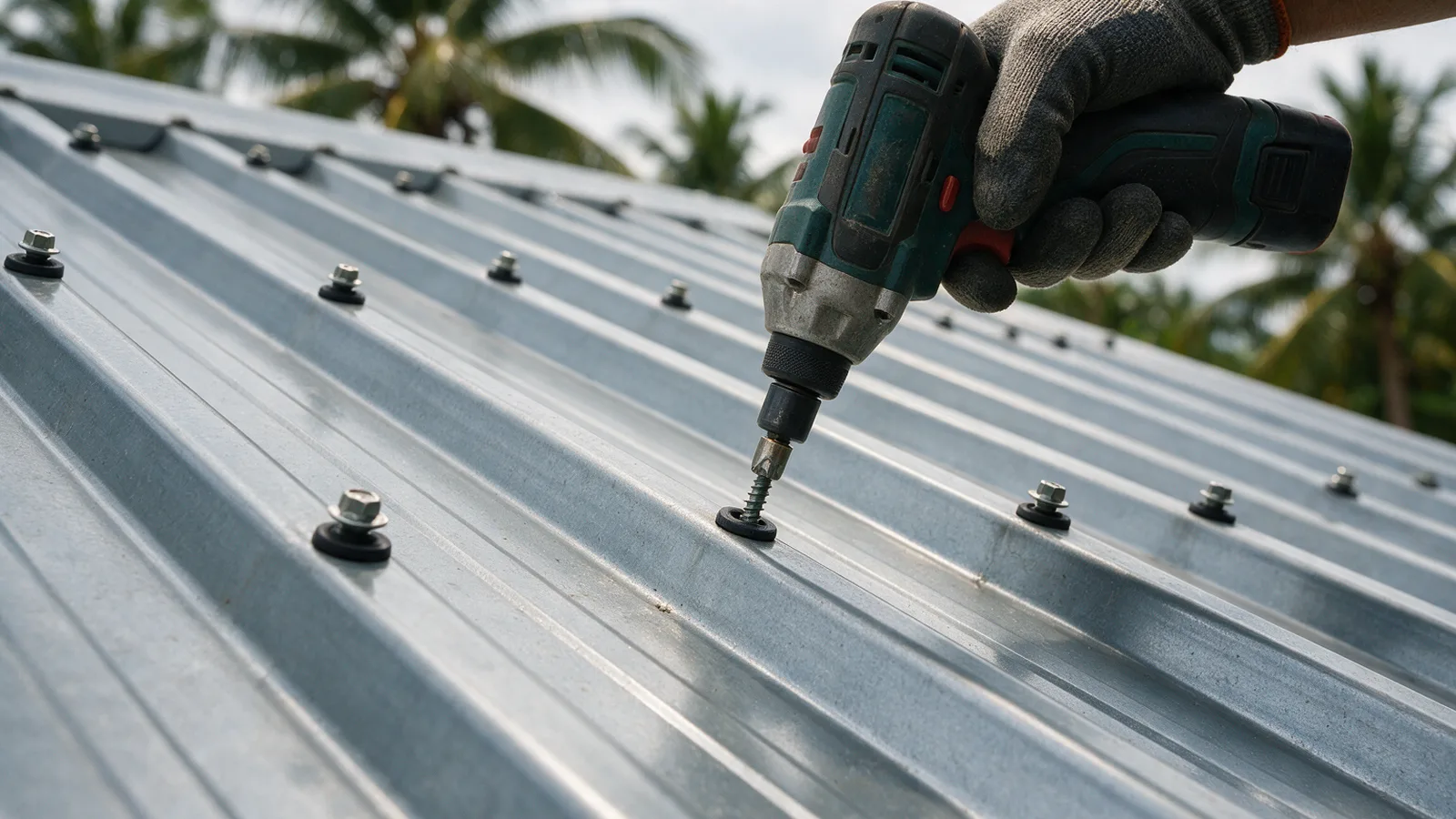
- A metal roof sheet's screw count is set per sheet at each support, and the job total is the fasteners per support times the number of sheets times the number of supports.
- Lysaght's installation manual gives the most common practice for its CUSTOM ORB corrugated profile as 3 fasteners for internal spans and 5 for single and end spans.
- Lysaght recommends crest fixing for its pierce-fixed roof profiles; it shows valley fixing for walls only. Follow the sheet maker's own fixing diagram.
- Over-tightened screws may split the sealing washer or deform the sheet, and either can let water in.
- Where insulation or packers sit under the sheet, the screw may need to be longer, with at least one full thread past a steel support.
On this page9 sections
How many screws does a metal roof sheet need?
A metal roof sheet needs a set number of screws at every support it crosses, and that number depends on the sheet profile and on whether the span is internal or at an end. Lysaght's installation manual gives a simple job total: fasteners per support, times the number of sheets, times the number of supports. End spans and single spans usually take more screws than internal spans.
For its CUSTOM ORB corrugated profile, Lysaght's Roofing & Walling Installation Manual states that the "most common practice is: 3 fasteners for internal spans and 5 fasteners for single and end spans." Concealed-fixed profiles work differently: KLIP-LOK sheets are held by clips, with 2 fasteners per clip for KLIP-LOK 406 and 3 per clip for the KLIP-LOK 700 profiles.
The manual is Lysaght's Australian edition, so the product names and tables are its own; a Malaysian supplier's data for the profile on your drawings comes first. For how far apart the supports themselves sit, see our guide to purlin and batten spacing for a metal roof.
How do you work out the number of roofing screws for a job?
To work out the number of roofing screws for a job, count the sheets across the roof and the supports (purlins or battens) each sheet crosses, then multiply both by the fasteners the profile needs at each support. Side-lap (where a lap needs one), flashing and accessory fasteners are counted separately.
Lysaght's manual sets this out as "n x (Number of sheets) x (Number of supports)" for pierce-fixed cladding, where n is the number of fasteners per support for that profile. Its Table 3.8 also gives a per-square-metre guide. A few rows from that table:
| Profile (Lysaght) | Fasteners per sheet width | Per m² at 1,200 mm spacing |
|---|---|---|
| CUSTOM ORB | 3 | 4 |
| SPANDEK | 3 | 4 |
| TRIMDEK | 4 | 5 |
| KLIP-LOK 406 | 2 (1 clip) | 5 |
The wider the support spacing, the fewer screws per square metre: in the same table, CUSTOM ORB at 3 fasteners per sheet width falls from 9 per m² at 450 mm spacing to 3 per m² at 1,800 mm. Lysaght presents Table 3.8 as a guide for a typical installation; for how wind acts on a metal roof, see our guide to wind uplift on metal roofs.
Where should screws go on a metal roof sheet?
On a roof, Lysaght's manual recommends crest fixing, through the top of the rib, for its pierce-fixed roof profiles (CUSTOM ORB, SPANDEK and TRIMDEK among them), and shows valley fixing for walls only. Other makers' sheets may differ, so follow the fixing diagram for the profile on your drawings. The manual also marks the underlapped edge of a side-lap as a place not to fix, because the underlapped sheet would leak there.
Where a screw goes through the rib, the manual recommends a screw with a "top thread section," which grips the sheet, draws it towards the seal and helps keep water out. Side-laps are a separate case: where roofing is laid to the recommended support spacings, the manual says "side-lap fasteners are generally not required between the supports," and adds them where a lap needs one, such as a sheet laid slightly out of line, the end of an overhang or a lap opened by insulation. Where they are used, side-lap fasteners "are often placed at about 900mm centres."
How tight should a roofing screw be?
A roofing screw should be tightened only until its sealing washer is gripped firmly enough to make a weathertight seal, and no further. An over-driven screw can split the washer or deform the sheet, and either can let water in at the hole.
Lysaght's manual is direct about the risk: fasteners "should not be over-tightened because this may split the sealing washer or deform the sheet, either of which could lead to water penetration." It asks for particular care when fixing in the valley, where the sheet sits hard against its support, and for every screw to be driven perpendicular to the sheet so the washer is not distorted.
"Fasteners with sealing washers should be tightened only until the washer is gripped firmly enough to provide a weathertight seal."
Which screws and washers suit a coated steel roof?
A coated steel roof needs screws whose own coating matches the roof's exposure, and sealing washers made of EPDM rubber rather than neoprene. Lysaght's manual recommends a sealing washer wherever a screw penetrates the roof sheet, made of a non-conductive EPDM rubber, and warns that washers on COLORBOND finishes must avoid significant conductive carbon black, particularly in marine environments.
The manual requires fasteners to carry a coating system meeting AS 3566.1, recommends stainless steel fasteners "only with COLORBOND Stainless steel," and specifies aluminium blind rivets for fixing flashings and side-laps on ZINCALUME and COLORBOND steel. For coated steel thicknesses and finishes, see our guide to roof sheet thickness: BMT, TCT and APT.
What do roofing screw codes like 12-14 x 50 mean?
A roofing screw code such as 12-14 x 50 gives three numbers: the screw gauge, the thread pitch and the overall length. In Lysaght's format, 12 is the gauge (the thread's outside diameter), 14 is the threads per inch and 50 is the length in millimetres from under the head to the tip of the drill point. An M prefix, as in M6-11 x 50, marks a metric size.
The manual's own side-lap and flashing list shows how specific the choice is: RoofZips M6-11 x 25, a Designer Head M5-16 x 25, hex-head Metal Teks 10-16 x 16 with seal, or 4.8 mm sealed aluminium blind rivets, for most profiles.
Do screws need to be longer over roof insulation?
Screws may need to be longer where insulation blankets, boards or foam packers sit between the roof sheet and its support, because the screw must still reach the support with enough thread. Lysaght's manual says the screw length may need to increase depending on the density and thickness of the insulation, board or packer.
Into steel, the manual says there should generally be "at least one full thread protruding past the support," and that three visible threads, even partial ones, meet the requirement. Into timber, the screw must reach the same embedment it would have without insulation. For deep insulation, it suggests checking with the screw manufacturer and running a site trial. Our guide to metal roof heat and U-values covers the insulation itself.
Who can help with a metal roof in Malaysia?
Ducero, based in Telok Panglima Garang, Selangor, supplies roofing and light-gauge steel roof trusses, and its work covers metal deck roofing, cladding and reroofing. Send the drawings or roof details through the contact page and ask about the profile and fixing on your project when you request a quotation.
Our guides to repairing or replacing a metal roof and reroofing an occupied building explain how to decide. Send your drawings or roof details through the contact page.
Frequently asked questions
How many screws per metal roof sheet do I need?
It depends on the profile and the span. Lysaght's installation manual counts fasteners per sheet at each support: for its CUSTOM ORB corrugated profile, the most common practice is 3 fasteners for internal spans and 5 for single and end spans. Multiply by the number of sheets and supports for the job total.
Should roofing screws go in the crest or the valley?
Lysaght's manual recommends crest fixing for its pierce-fixed roof profiles, such as CUSTOM ORB, SPANDEK and TRIMDEK, and shows valley fixing for walls only. It also warns against fixing the underlapped side of a side-lap, which would leak. Follow the sheet maker's diagram for your profile.
What happens if a roofing screw is over-tightened?
Lysaght's manual warns that over-tightening may split the sealing washer or deform the sheet, either of which could lead to water penetration. Tighten only until the washer is gripped firmly enough to seal.
What do the numbers on a roofing screw mean, such as 12-14 x 50?
In Lysaght's format, the first number is the screw gauge, the second is the thread pitch in threads per inch, and the last is the overall length in millimetres, measured from under the head to the tip of the drill point. An M prefix, as in M6-11 x 50, means a metric size.
Do I need longer screws when there is insulation under the roof sheet?
You may. Lysaght's manual says screw length may need to increase with the density and thickness of insulation, boards or packers under the cladding, and that into metal there should generally be at least one full thread protruding past the support.
How do I ask Ducero about roofing for a project?
Ducero's work covers metal deck roofing, cladding, reroofing and light-gauge steel roof trusses. Send the building's location, the roof size and the profile on the drawings through the contact page at ducero.com.my/contact-us.php, or call +603 3123 1348.