
Key takeaways
- Roof sheet thickness is quoted three ways: BMT (the steel alone), TCT (steel plus metallic coating) and APT (after painting).
- NS BlueScope Malaysia cites 0.42 mm BMT as the recommended minimum for steel roofing under the JKR Standard Specifications for Building Works 2020.
- In BlueScope Malaysia's table, a 0.42 mm BMT COLORBOND sheet measures 0.47 mm TCT and 0.50 mm APT, so the same sheet can be described by three numbers.
- For the same profile, a thicker sheet can span further between purlins: Lysaght's Australian manual lists CUSTOM ORB at 1,200 mm internal spacing in 0.42 mm and 1,700 mm in 0.48 mm.
- Ask every supplier for the BMT in writing, and check the delivered sheets with a micrometer against the matching TCT or APT.
On this page9 sections
How thick should a metal roof sheet be in Malaysia?
The recommended minimum base metal thickness (BMT) for a steel roof sheet in Malaysia is 0.42 mm, the minimum NS BlueScope Malaysia cites from the JKR Standard Specifications for Building Works 2020. The right thickness for a particular roof can be more than that: it depends on the profile, the support spacing, foot traffic and the design wind load, so the drawings should state the BMT for each roof.
BlueScope Malaysia's 2025 thickness guide puts the minimum in one sentence:
"The recommended minimum base metal thickness for steel roofing is 0.42mm as specified in JKR Standard Specifications for Building Works 2020 (Section G Roofing Works, Clause 6.1.2)."
The same guide illustrates what insufficient base metal thickness can lead to, captioning its examples "Collapse of roofing sheet" and "Crack easily at ribs."
What do BMT, TCT and APT mean?
BMT, TCT and APT are three ways of measuring the same roof sheet. BMT, base metal thickness, is the steel alone. TCT, total coated thickness, adds the metallic alloy coating that protects the steel. APT, after painted thickness, adds the primer and paint layers of a pre-painted sheet. A quoted thickness means little until you know which of the three it is.
BlueScope Malaysia explains that a metallic-coated finish has "coating up to the Aluminium/Zinc alloy layer," while a pre-painted finish adds primer, a finish coat and a backing coat. Its summary table shows how far apart the three numbers sit for the same steel:
| BMT (steel) | TCT (coated) | APT (painted) |
|---|---|---|
| 0.35 | 0.40 | 0.43 |
| 0.42 | 0.47 | 0.50 |
| 0.48 | 0.53 | 0.56 |
| 0.55 | 0.60 | 0.63 |
The gap between BMT and TCT is the metallic coating. The guide notes that, according to AS 1397, the approximate coating thickness of AZ150 is 0.05 mm and of AZ200 is 0.06 mm. An unpainted ZINCALUME sheet has no APT figure, because it has no paint.
Why can two "0.47 mm" roof sheets be different?
Two roof sheets both sold as 0.47 mm can be different because one figure may be the base metal thickness and the other the total coated thickness. In BlueScope Malaysia's table, a 0.42 mm BMT sheet measures 0.47 mm TCT, so a quote that says "0.47 mm" without saying which measure could describe a sheet with less steel in it than one quoted at 0.47 mm BMT.
The same applies to painted sheet. A 0.42 mm BMT COLORBOND sheet measures 0.50 mm after painting, so a sheet described only as "0.50 mm" may be a 0.42 mm BMT product. Neither description is wrong, but only the BMT tells you how much steel is in the sheet. When comparing quotes, put the BMT, the coating class and the paint system side by side, not just one thickness.
Does sheet thickness change how far a roof sheet can span?
Yes. For the same profile, a thicker sheet can usually span further between purlins or battens, because more steel carries the load between supports. Lysaght's roofing specification table shows the effect: each of the three profiles below is listed in 0.42 and 0.48 mm, with a longer recommended support spacing for the thicker sheet.
Recommended maximum internal support spacing in Lysaght's Table 2.12.1, by BMT:
| Profile | 0.42 mm BMT | 0.48 mm BMT |
|---|---|---|
| CUSTOM ORB | 1,200 mm | 1,700 mm |
| SPANDEK | 2,400 mm | 3,000 mm |
| KLIP-LOK 700 HI-STRENGTH | 2,200 mm | 2,800 mm |
The manual bases these roof spacings on "adequate performance of claddings under concentrated loading (incidental for maintenance)," and refers designers to product publications for wind pressure data, so wind design can call for closer supports.
These are Lysaght's values for its own profiles in its Australian manual; check the documents for the exact sheet you are buying. Our guide to purlin and batten spacing for a metal roof explains how the spacing is chosen, and the minimum roof pitch for a metal roof covers the slope each profile needs.
How does the coating affect a roof sheet's life?
The coating affects a roof sheet's life because it is what protects the base steel from corrosion. BlueScope Malaysia's guide reports that "tests show higher metallic alloy coating thickness will have longer lifespan," and that coating type matters too: Type "AZ" aluminium-zinc coating "has significantly longer lifespan than Type 'Z' coating (GI)," the galvanised coating.
For painted sheet, the paint must also be applied consistently. The same guide warns that "poor control of paint thickness during coil painting process will result in paint peels off and inconsistent colour fading." When you compare roof sheets, the coating class (for example AZ150 or AZ200) is as important to ask about as the BMT. Our guide to choosing metal deck roofing covers coating choice for coastal and industrial sites.
How do you check the thickness of delivered roof sheets?
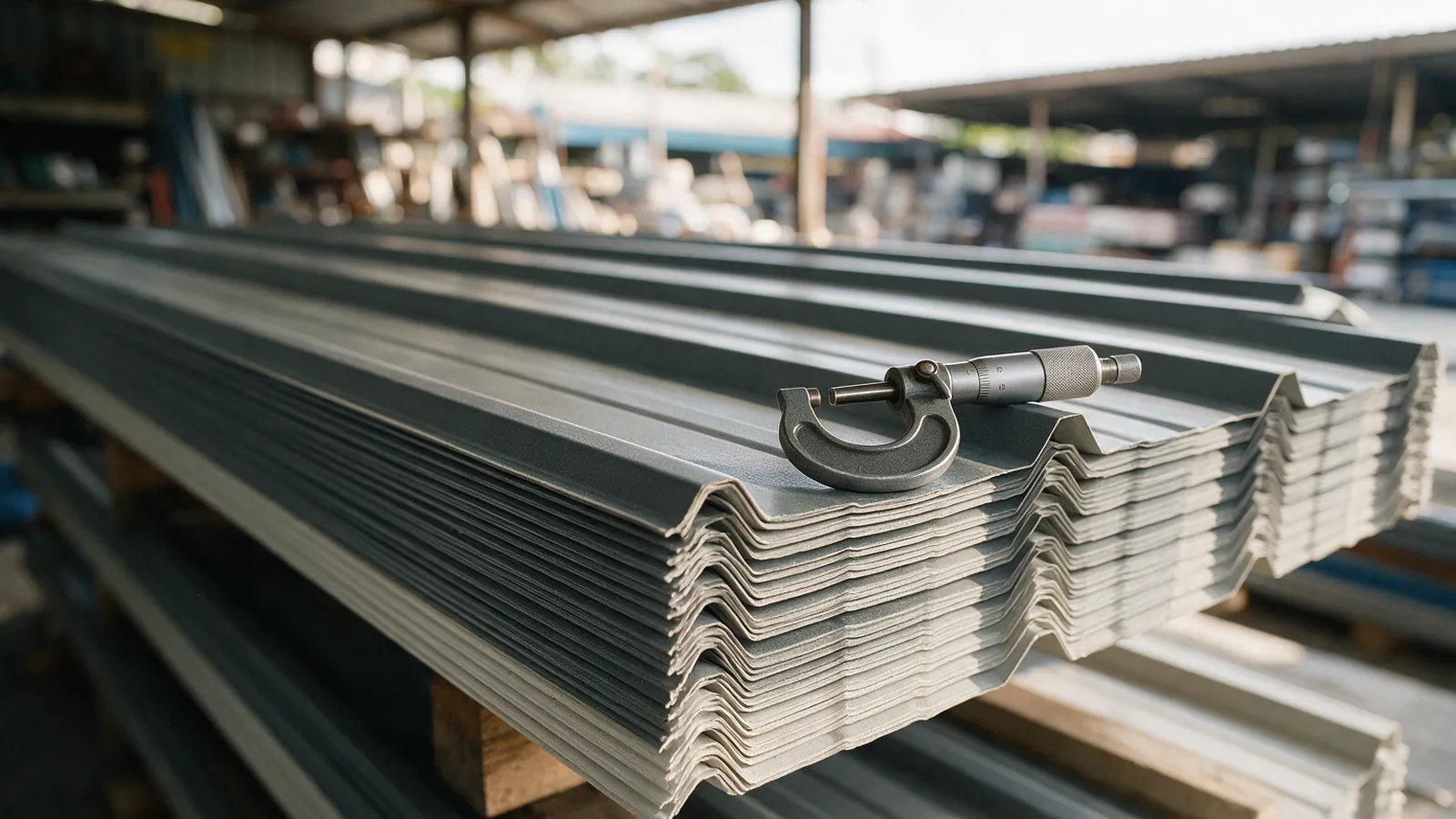
Check delivered roof sheets with a micrometer, and compare the reading with the coated or painted thickness that matches the BMT you ordered. BlueScope Malaysia notes that the thickness after metallic coating (TCT) and the thickness after painting (APT) "can be measured using a micrometer."
- Get the BMT in writing. The quotation and delivery order should state the BMT, the coating class and, for painted sheet, the paint system.
- Look up the matching TCT or APT in the manufacturer's thickness table for that BMT.
- Measure the sheets with a micrometer and compare the readings with the table, allowing for the manufacturer's stated tolerances.
- Raise any shortfall before installation, while the sheets can still be returned or replaced.
How can Ducero help with roof sheets?
Ducero's work covers metal deck roofing, cladding and reroofing, alongside light-gauge steel roof trusses. Send the building's location, the roof dimensions, and the profile and BMT shown on the drawings through the contact page, or call +603 3123 1348. Replacing an existing roof? See whether to repair, reroof or replace a metal roof.
Frequently asked questions
What is the minimum thickness for a steel roof sheet in Malaysia?
NS BlueScope Malaysia states that the recommended minimum base metal thickness for steel roofing is 0.42 mm, as specified in the JKR Standard Specifications for Building Works 2020 (Section G Roofing Works, Clause 6.1.2). The design for a particular roof may call for more.
What is the difference between BMT and TCT?
BMT, base metal thickness, is the steel alone. TCT, total coated thickness, is the steel plus its metallic alloy coating. On a painted sheet, APT, after painted thickness, adds the paint layers. In BlueScope Malaysia's table, a 0.42 mm BMT COLORBOND sheet is 0.47 mm TCT and 0.50 mm APT.
Is a 0.47 mm roof sheet the same as a 0.47 mm BMT sheet?
Not necessarily. A figure of 0.47 mm may be the total coated thickness of a 0.42 mm BMT sheet. Ask the supplier to state the BMT.
How can I check a roof sheet's thickness on site?
With a micrometer. BlueScope Malaysia notes that the thickness after metallic coating (TCT) and after painting (APT) can both be measured with a micrometer; compare the reading with the supplier's TCT or APT figure for the BMT ordered.
Does a thicker roof sheet allow wider purlin spacing?
For the same profile, yes. In Lysaght's Australian specification table, for example, its CUSTOM ORB profile's recommended internal support spacing rises from 1,200 mm at 0.42 mm BMT to 1,700 mm at 0.48 mm BMT. Wind design can reduce these spacings.
How do I ask Ducero about roof sheets for a project?
Ducero's work covers metal deck roofing, cladding and reroofing. Send the building's location, the roof dimensions and the profile and BMT on the drawings through the contact page at ducero.com.my/contact-us.php, or call +603 3123 1348.
Sources
- NS BlueScope Malaysia, Not all thickness quoted mean the same: Malaysia COLORBOND coated steel thickness (2025). Citing the JKR Standard Specifications for Building Works 2020, Section G, Clause 6.1.2, and AS 1397.
- Lysaght, LYSAGHT Roofing & Walling Installation Manual, section 2.3 and Table 2.12.1. An Australian manual for its own profiles; product data, not a Malaysian design code.