
Key takeaways
- Solar panels shade the roof sheet beneath them: on a San Diego laboratory, UC San Diego researchers measured the ceiling under a tilted array up to 2.5°C cooler than under bare roof, with the largest difference around 6 pm.
- The effect is local, reaching the top-floor rooms directly under the panels rather than the whole building.
- In a measured Malaysian case at Universiti Teknologi PETRONAS in Perak, PV panels on the roof cut the measured power consumption of one postgraduate office, in a low-cost building, by 9.7%, about 3.42 kWh a day.
- Insulation, roof construction, coverage, the air gap, roof colour and the number of floors decide the size of the effect; under a well-insulated roof it can be very small.
- To know the effect on your building, log ceiling temperatures and sub-meter the air-conditioners under the panels, before and after.
On this page12 sections
Do solar panels make the roof below them cooler?
Yes. A solar panel mounted above a roof sheet shades it, so the sheet under the panel and the ceiling below run cooler than bare roof in the sun. UC San Diego researchers measured this on one laboratory roof carrying tilted panels, flush-mounted panels and uncovered sections side by side: by day, the ceiling under the tilted array was up to 2.5°C cooler than the ceiling under the exposed roof.
The study, by Anthony Dominguez and Jan Kleissl of UC San Diego with Jeff Luvall of NASA, was published in Solar Energy in 2011. On that concrete laboratory, which has no air-conditioning, the team's 2010 abstract places the largest difference "at around 1800h, close to typical time of peak energy demand." The university's release adds that the panels reduced the heat reaching the roof by about 38 percent for that building, and its thermal image shows the tilted array's footprint as a cool area on the ceiling: rooftop solar cooling sits under the panels.
"Rather than the sun beating down onto the roof, which causes heat to be pushed through the roof and inside the ceiling of the building, photovoltaic panels take the solar beating. Then much of the heat is removed by wind blowing between the panels and the roof."
How does a solar panel keep heat out of the room below?
A solar panel keeps heat out of the room below by taking the sun's energy before it reaches the roof sheet. The panel turns part of that energy into electricity and heats up with much of the rest, but it loses much of that heat to the air moving around it, including through the gap beneath. The shaded sheet stays cooler, so less heat passes into the ceiling void and the room.
- The panel takes the sun. With conversion efficiency of 5 to 20% and installed solar reflectance of 16 to 27% (2010 figures), the UC San Diego team calculates that "53-79% of the solar energy heats the panel."
- The hot panel sheds that heat both ways. The UC San Diego abstract notes that most of it "is then either transferred to the atmosphere or the building underneath." Air moving through the gap carries part of the downward share away before it reaches the sheet.
- The shaded sheet stays cooler than the bare sheet beside it.
- Less heat crosses into the ceiling void and on through the ceiling. For their study building, the UC San Diego team's heat-flow model put the peak roof heat flux "63% lower under the tilted PV array."
- The air-conditioner below has less heat to remove.
The shaded sheet still gets some heat from above: the warm underside of the panel radiates heat down onto it, and air moving through a taller, more open gap keeps that underside and the sheet cooler.
This matters in Malaysia because the roof is where most heat enters a house or a single-storey building such as a factory: a 2014 Universiti Sains Malaysia review of tropical houses in Southeast Asia puts the roof's share at "70% of the total heat gain." How heat crosses a bare metal roof is covered in our guide to metal roof heat and the roof U-value rule.
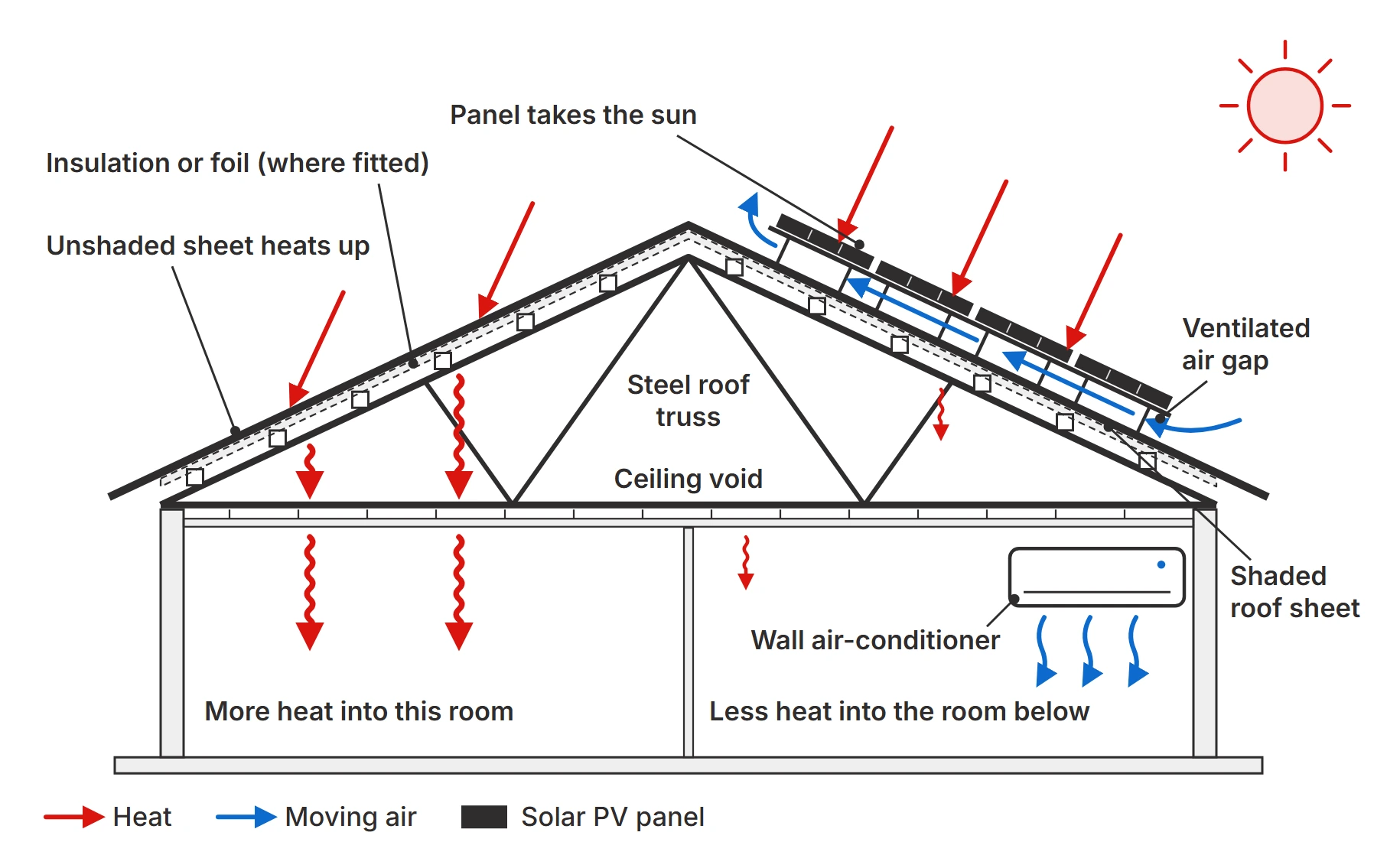
- 1Unshaded sheet heats up
- 2Insulation or foil (where fitted)
- 3Panel takes the sun
- 4Ventilated air gap
- 5Shaded roof sheet
- 6Steel roof truss
- 7Ceiling void
- 8Wall air-conditioner
- 9More heat into this room
- 10Less heat into the room below
Does a cooler roof mean less air-conditioning?
A cooler roof can mean less air-conditioning for the rooms directly under the panels, because a cooler ceiling leaves the air-conditioner less heat to remove. Studies in Malaysia and Thailand have measured or estimated it. Each figure belongs to its own building and climate, is separate from the electricity the panels generate and is no forecast for yours; this guide makes no savings estimate of its own.
At Universiti Teknologi PETRONAS in Seri Iskandar, Perak, Hussain Al-Kayiem and colleagues monitored a postgraduate office in a low-cost building before and after a set of PV panels was installed on its roof, and measured its air-conditioning energy. They report that "the implementation of PV panels has reduced the power consumption by 9.7%, which is about 3.42 kWh/day" (presented at ICPER 2020 and published by Springer).
In Thailand, Sorraphat Bubpharam and colleagues used a year of data from a 25 kWp array on metal sheet roofing to estimate savings of 0.038 to 0.052 kWh per square metre per day, "equivalent to an electricity saving of approximately 6.33 kWh/m2/year from air conditioner use." The largest reductions came under high solar irradiance and high ambient temperature.
What did the studies on solar panels and roof heat actually measure?
The studies measured or modelled different things in different places, so their numbers cannot be swapped: ceiling temperature, heat flow through the roof, air-conditioning energy, or the air above the panels. The table gives each study's place, building, method and result as its authors report them, including studies that found little or no benefit reaching the rooms below.
| Study | Place and climate | Building and roof | Measured or modelled | Reported result |
|---|---|---|---|---|
| Dominguez and colleagues (2010 abstract; Solar Energy 2011) | San Diego, USA; coastal, clear April days | Concrete laboratory, no air-conditioning; roof albedo 0.19 | Measured: ceiling temperature (thermal camera) | Ceiling up to 2.5°C cooler by day under the tilted array; warmer at night, most under the flush array |
| Al-Kayiem and colleagues (2023) | Perak, Malaysia | Postgraduate office in a low-cost building | Measured: air-conditioning energy, before and after | Power consumption down 9.7%, about 3.42 kWh a day |
| Bubpharam and colleagues (2023) | Thailand | 25 kWp array on metal sheet roofing; one year of data | Modelled from a year of data: heat gain | About 6.33 kWh/m² a year of air-conditioner electricity (estimate) |
| Ma and colleagues (2023) | Wuhan, China; hot summer | Top-floor room (model) | Modelled, checked on an experimental platform: roof temperature and heat gain | Roof peak temperature 22.9°C lower; daily heat gain 74.84% lower |
| Ban-Weiss and colleagues (2013) | Yuma, Arizona, USA | Office; thin-film PV laminated to a white membrane (no air gap) over insulation, ventilated attic | Measured: roof temperature and heat flows | Summer daily mean roof surface about 5°C cooler; heat into the conditioned space "minimally affected" |
| Chen and colleagues (2025) | Humid subtropical; July 2024 heatwaves | Rooftop PV against bare roof; top-floor spaces simulated | Measured: air temperature. Simulated: top-floor cooling energy | Air over the PV more than 5°C warmer; net 1.5% more cooling energy |
| Odeh (2018) | Australian dwellings; AccuRate simulation | Dwellings with varied roof insulation and floors | Simulated: annual heating and cooling load | Shading effect negligible as the number of floors increases |
What decides how big the cooling effect is?
Six things decide how much cooler the room under a solar array gets: how well the roof is already insulated, what the roof is made of, how much of the roof the panels cover and which rooms sit beneath them, how high and open the air gap is, how reflective the roof surface is, and how many floors lie between the roof and the room. Weather and air-conditioning hours decide the rest.
- Roof insulation. On the insulated Yuma office, heat flux from the ventilated attic into the conditioned space "was minimally affected by the BIPV, suggesting that the roof was decoupled from the conditioned space." Odeh found the annual load insensitive to the rooftop system "only because the total thermal resistance is dominated by roof insulation."
- Roof construction. A thin metal deck heats up and cools down quickly, so shade over it cuts the heat entering the ceiling void during the sunny hours; a heavy concrete or tiled roof stores heat and gives it back later, so shade changes when heat arrives as well as how much (in the Wuhan model, the panels increased the roof's heat delay by 0.5 h). None of the studies found for this guide measured a tiled house roof.
- Coverage. Only the rooms under the array are shaded, so a part-covered roof gives a part-building effect.
- Air gap and tilt. UC San Diego's release notes that "the benefits are greater if there is an open gap where air can circulate between the building and the solar panel, so tilted panels provide more cooling."
- Roof colour. In the Wuhan modelling study, "high-reflectance roofs lead to a 10.8% increase in indoor heat gain when the photovoltaic panel is installed." Kleissl himself noted: "There are more efficient ways to passively cool buildings, such as reflective roof membranes."
- Number of floors. Odeh found that "with an increasing number of floors in the dwelling, the effect of shading by PV panels on thermal performance becomes negligible."
Can solar panels make a building warmer?
Solar panels can make parts of a building warmer in some conditions. At night, panels block the roof's heat loss to the open sky, so ceilings under them stay warmer than under bare roof. In one 2025 heatwave study, hot panels warmed the air over the roof, and in simulated top-floor rooms that warming cancelled the shading benefit. These effects limit the cooling side effect and can reverse it.
At night a bare roof sheet loses heat by radiating it to the open sky. A panel above the sheet blocks that view of the sky, so the sheet and the ceiling under it stay warmer. The UC San Diego team's 2010 slides put it simply: "PV acts as insulator," with the flush array the best insulator at night. Their roof was measured on clear April days on the California coast. In Malaysia the effect works against rooms air-conditioned at night, such as bedrooms; no study found for this guide has measured its size under Malaysian night skies.
A 2025 study of July 2024 heatwaves in a humid subtropical climate also found that "PV installations elevated ambient temperatures by over 5 °C compared to conventional bare roof," and in its simulations of top-floor spaces that warming "fully offset shading benefits, resulting in a net 1.5 % increase in cooling energy demand." That is one climate, but a fair warning that the side effect is not always a saving.
Can solar panels replace roof insulation?
No. Solar panels shade part of a roof, but they are not part of the roof build-up that insulation rules describe, and they shade only the area they sit over. In Selangor, by-law 38A(2) caps the roof U-value of all buildings at 0.4 W/m²K for a light weight roof under 50 kg/m², and a metal roof reaches that through its insulation, air space and ceiling.
The by-law's wording ends "unless provided with other shading or cooling means." Whether a PV array counts is for the submitting professional and the local authority to decide, and this guide makes no claim either way; see what the roof U-value rule asks for.
How can you measure the cooling effect on your own building?
Measure it the way the researchers did: compare shaded and unshaded parts of the same roof at the same time, and compare the air-conditioning energy of the rooms under the panels before and after installation. Temperature loggers on the ceiling or the underside of the roof sheet, and a sub-meter on the air-conditioners serving those rooms, give a building owner evidence instead of an estimate.
- Log before installing: loggers on the ceiling or sheet underside, in the zone the panels will cover and in one that stays bare, over a few weeks of normal weather.
- Sub-meter the aircon units serving the rooms under the planned array, separately from the solar system's own meter.
- Hold everything else steady: thermostat settings, operating hours and occupancy.
- Repeat afterwards and compare like with like: sunny days with similar outdoor temperatures, over the same hours.
- Keep the two benefits apart: the panels' generation is read from the inverter or meter; the cooling side effect is only the change in the air-conditioners' own consumption.
The UC San Diego team pointed to a stronger test still: to "compare two climate-controlled, identical buildings in the same neighborhood, one with solar panels, the other without," which a developer of identical units is well placed to run.
What should be checked before solar panels go on the roof?
Before solar panels go on, the roof must be checked as a structure, not just as a surface: the trusses, purlins, sheets and fixings carry the array's weight and wind uplift, and the sheet under the array becomes hard to reach afterwards. Both of the Energy Commission's main routes for rooftop solar in Peninsular Malaysia require the structural design to be certified by a qualified, competent person.
The Solar ATAP guidelines (GP/ST/No. 60/2025) require certification under "the Registration of Engineers Act 1967 and the Architects Act 1967 in relation to the structure of mounting the PV panels," and an application lists an "Endorsed Civil and Structure drawing for solar PV installation." The self-consumption (SELCO) guidelines require structural drawings to be "prepared and certified by a qualified and competent person."
- Roof condition: deal with worn sheets and fasteners before they are covered (see whether to repair, reroof or replace a metal roof).
- Mounting: our 10 checks for solar mounting on a metal roof cover fixings, compatible metals and wind.
How does a solar array change the roof's design?
The panels and rails add permanent load that the trusses and purlins must carry. Wind pushes and lifts the panels, and the rails pass that force into the roof through their fixings, so how they fix (into the purlins, or clamped to the ribs or seams of a concealed-fix sheet) is part of the structural design, not a site decision. A taller, more open gap that helps cooling also changes the wind forces on the array, so ask how far the panels will sit above the sheet: the engineer and the mounting manufacturer settle the gap height and the fixings together. On a new building, the truss design can allow for the array, a maintenance walkway and the cable route from the start (see how to choose a steel roof truss system).
How can Ducero help with a solar roof?
Ducero's work covers metal deck, cladding and light-gauge steel roof trusses. Its sister company Sunrise Prima, established in 2023, provides engineered solar mounting structures for solar PV installations, in strategic collaboration with Solar Sentinel, whose services cover consultancy, design, supply, installation, and testing and commissioning of complete solar PV systems. See the solar mounting structures page and the roofing page. Then, through the contact page, send the roof's location, size and build-up (sheet, insulation, ceiling) and say which rooms below are air-conditioned, or call +603 3123 1348.
Frequently asked questions
Do solar panels make a house hotter?
Usually not by day in the rooms under the panels: UC San Diego researchers measured a laboratory ceiling up to 2.5°C cooler under a tilted array. But the effect can reverse. At night those ceilings stayed warmer, and a 2025 heatwave study in a humid subtropical climate found the panels warmed the air over the roof by more than 5°C, with a net 1.5% rise in simulated top-floor cooling energy.
Which rooms benefit from the cooling effect of rooftop solar panels?
Mainly the top-floor rooms directly under the panels. UC San Diego's thermal image showed the array's footprint as a cool area on the ceiling, and Odeh's 2018 simulations found the shading effect becomes negligible as the number of floors increases. Rooms under bare roof see little or no change.
How much will solar panels cut my air-conditioning bill?
There is no reliable general figure, and this guide gives none. One postgraduate office in a low-cost building at Universiti Teknologi PETRONAS recorded a 9.7% cut in power consumption, about 3.42 kWh a day; a Thai study of one 25 kWp array on a metal sheet roof estimated about 6.33 kWh of air-conditioner electricity per square metre a year. Neither figure is a forecast for your building: measure it before and after.
Is a white roof or solar panels better for keeping a building cool?
For cooling alone, a reflective roof: UC San Diego's Jan Kleissl said there are more efficient ways to passively cool buildings, such as reflective roof membranes. The two also interact: a Wuhan modelling study reports that "high-reflectance roofs lead to a 10.8% increase in indoor heat gain when the photovoltaic panel is installed." On an insulated Yuma office, researchers judged the PV roof's main benefit to be its electricity, not reduced heat flow.
Does the gap under the solar panels matter?
Yes. UC San Diego's release says the benefits are greater where air can circulate between the building and the panel, so tilted panels provided more cooling, and the team found ceilings under a flush-mounted array warmer at night. The gap height comes from the mounting system's design and the engineer's wind calculation.
Sources
- UC San Diego Jacobs School of Engineering, Solar Panels Keep Buildings Cool, news release, 18 July 2011.
- A. Dominguez, J. Kleissl, M. Samady and J. C. Luvall, Effects of Solar Photovoltaic Panels on Roof Heat Transfer, AMS Ninth Symposium on the Urban Environment, 2010 (NASA Technical Reports Server). Published as Dominguez, Kleissl and Luvall, Solar Energy 85(9), 2244-2255, 2011, doi:10.1016/j.solener.2011.06.010.
- H. H. Al-Kayiem and colleagues, Influence of Life Green Wall and Roof Shedding on the Internal Thermal Condition of Buildings: Case Study in Malaysia, ICPER 2020, Lecture Notes in Mechanical Engineering, Springer, 2023 (online 4 October 2022), pp. 35-45.
- S. Bubpharam and colleagues, Quantifying the benefits of PV module shading for building heat gain reduction: A machine learning approach, Sustainable Energy Technologies and Assessments 60, 103428, 2023.
- Z. Ma and colleagues, Shading effect and energy-saving potential of rooftop photovoltaic on the top-floor room, Solar Energy 265, 112099, 2023.
- G. Ban-Weiss and colleagues, Electricity production and cooling energy savings from installation of a building-integrated photovoltaic roof on an office building, Energy and Buildings 56, 210-220, 2013 (Lawrence Berkeley National Laboratory).
- L. Chen and colleagues, The resilience paradox of rooftop PV: Building cooling penalties and heat risks, Building and Environment 282, 113233, 2025.
- S. Odeh, Thermal Performance of Dwellings with Rooftop PV Panels and PV/Thermal Collectors, Energies 11(7), 1879, 2018.
- K. M. Al-Obaidi, M. Ismail and A. M. Abdul Rahman, Passive cooling techniques through reflective and radiative roofs in tropical houses in Southeast Asia: A literature review, Frontiers of Architectural Research 3(3), 283-297, 2014.
- Selangor Uniform Building (Amendment) (No. 2) By-Laws 2012, Sel. P.U. 142, by-law 38A.
- Energy Commission (Suruhanjaya Tenaga), Guidelines for Solar Accelerated Transition Action Programme in Peninsular Malaysia, GP/ST/No. 60/2025.
- Energy Commission (Suruhanjaya Tenaga), Guidelines for Solar Photovoltaic Installation for Self-Consumption in Peninsular Malaysia, June 2026.