Key takeaways
- In Lysaght's comparison table (Australian summer conditions, for comparisons only), unpainted ZINCALUME roofing radiates about 25 W/m² from its underside, against 2.0 W/m² with reflective foil laminate under it; darker painted sheets radiate several times more without foil.
- Foil only works facing an air space: without one, Virginia Cooperative Extension warns, "the radiant barrier acts as a conductor".
- Rockwool lists its Cool 'n' Comfort stone wool as non-combustible, melting above 1,000°C.
- Lysaght's Australian manual allows normal-density blankets (up to 12 kg/m³) of up to 100 mm under its pierce-fixed sheets but 50 mm under KLIP-LOK 406 and its other concealed-fixed profiles; other makers' tables govern their sheets.
- Lysaght allows only neutral-cure silicone on sheet steel, and sealants "are NOT adhesives", so sealed laps still need rivets or screws.
On this page10 sections
What goes under a metal deck roof in Malaysia, and what does each layer do?
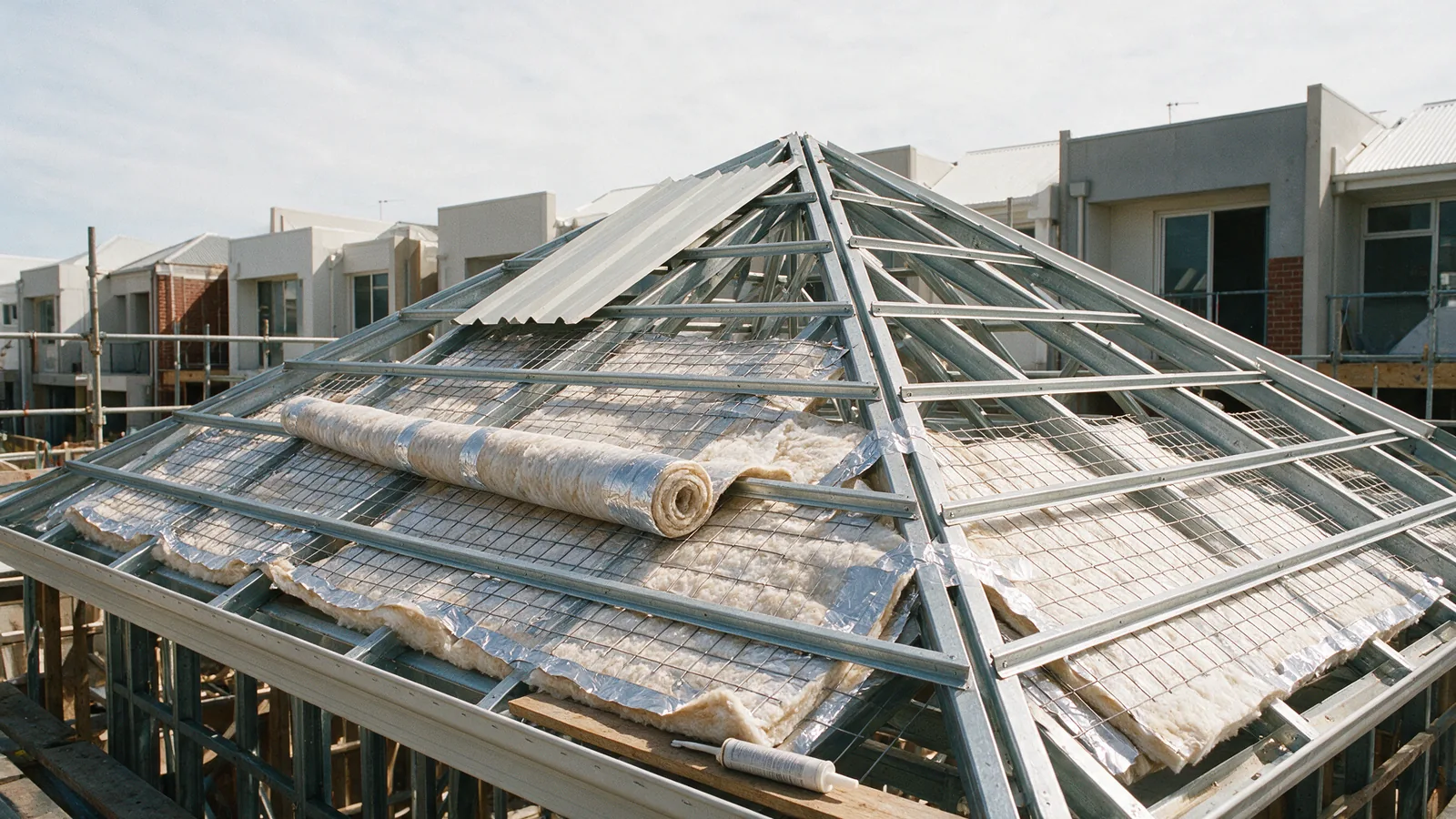
A typical insulated metal deck roof in Malaysia is built in four layers above the purlins: the metal deck sheet, an insulation blanket of glass wool or rock wool, an aluminium foil laminate, and a galvanised welded wire mesh, called BRC on site, that carries the foil and blanket between supports. Below them sit the truss or rafter, the roof space and the ceiling.
Lysaght's installation manual draws exactly this order in its figure of "typical roof insulation with foil and blanket": roofing, insulation blanket, reflective foil laminate, wire mesh. Rockwool describes the same single-skin roof for its stone wool, with the insulation "held by reinforcing steel wire mesh and aluminum foil rolled over purlins". Each layer has one job:
- Foil laminate reflects radiant heat and, with sealed laps, is the vapour barrier.
- Insulation wool slows conducted heat and damps rain noise.
- BRC wire mesh holds foil and wool up between purlins.
- Silicone sealant closes laps, flashings and penetrations, beside proper fixings.
In Selangor, by-law 38A(2) of the Uniform Building By-Laws caps a light roof (under 50 kg/m²) at a U-value of 0.4 W/m²K unless other shading or cooling is provided; how a metal roof meets it is in the roof U-value guide, and the sheets are on Ducero's roofing page.
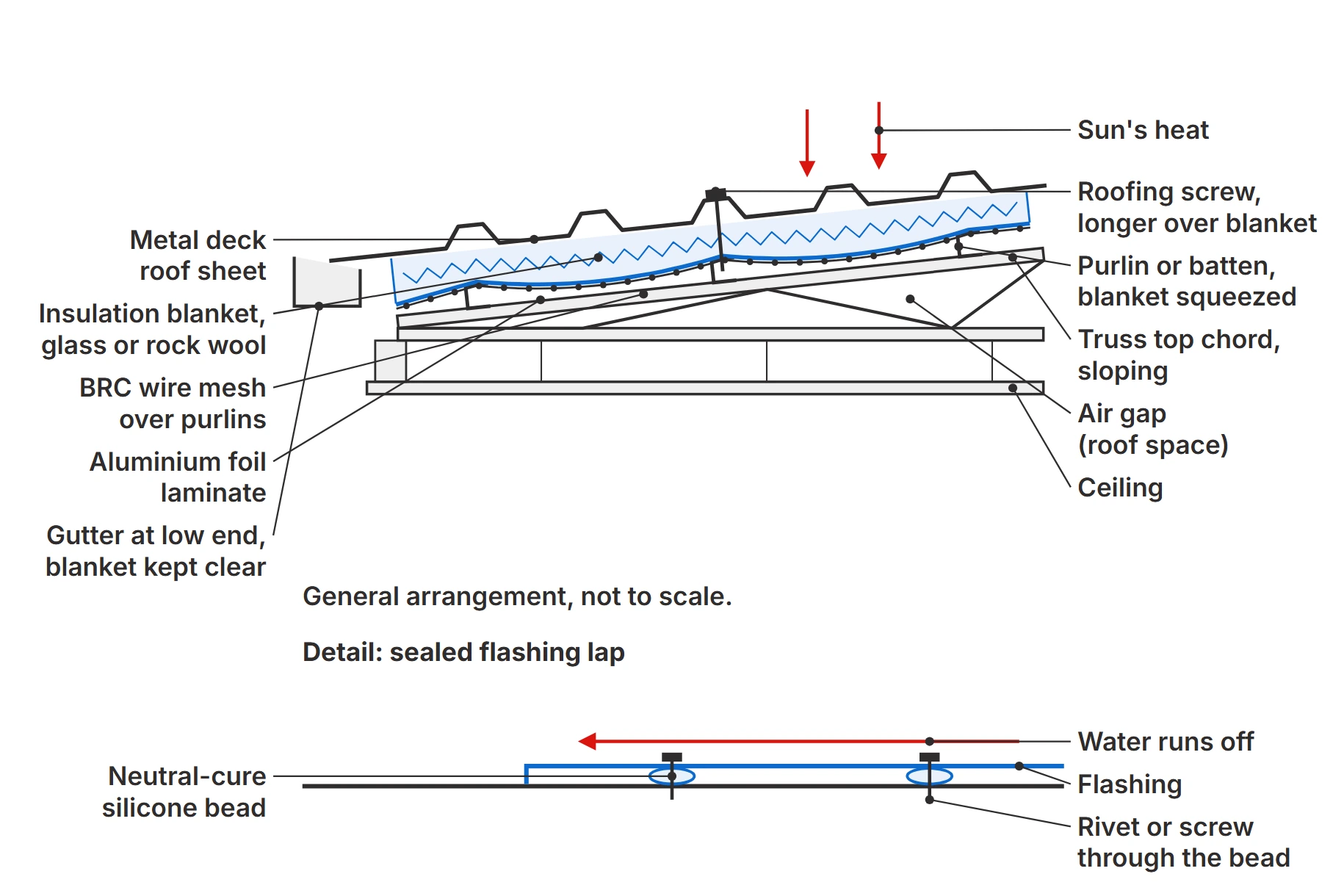
- 1Sun's heat
- 2Metal deck roof sheet
- 3Roofing screw, longer over blanket
- 4Insulation blanket, glass or rock wool
- 5Aluminium foil laminate
- 6BRC wire mesh over purlins
- 7Purlin or batten, blanket squeezed over it
- 8Truss top chord, sloping
- 9Air gap (roof space)
- 10Ceiling
- 11Gutter at the low end, blanket kept clear
- 12Water runs off
- 13Flashing (lap detail)
- 14Neutral-cure silicone bead
- 15Rivet or screw through the bead
Which aluminium foil suits a metal roof: woven or non-woven, single or double sided, bubble or foam?
Aluminium roof foils differ in their core and their faces. Woven foil is laminated to a woven polypropylene or polyethylene fabric; non-woven (paper) foil is laminated to kraft paper or film, often with a glass-fibre scrim for strength. Double-sided foil reflects from either face, single-sided foil only from its shiny face. Bubble foil and foam-backed foil add a thin layer of trapped air or foam, but the reflecting is still done by the foil itself.
Virginia Cooperative Extension describes reflective insulation as "aluminum foils with a variety of backings such as roof sheathing, kraft paper, plastic film, cardboard, bubble wrap", and notes that some have "a reflective surface on both sides so either side can face the open air space". RIMA International, the reflective insulation makers' association, says the air bubble in bubble foil "only contributes a small amount of resistance to heat flow by CONDUCTION" and "has no effect on the radiant transfer"; its other job is to hold the foil in place.
| Type | How it is made | What it does well | What to check |
|---|---|---|---|
| Woven foil | Foil laminated to a woven polypropylene or polyethylene fabric | The woven core reinforces the sheet for draping over purlins and site handling | Taped laps if it is also the vapour barrier |
| Non-woven (paper) foil | Foil laminated to kraft paper or film, often reinforced with a glass-fibre scrim | Smooth, low-stretch sheet; fire-retardant grades are sold | Tear strength, and the fire test it is sold to (some state BS 476 Parts 6 and 7) |
| Single-sided | One reflective face | Works when the shiny face looks into an air space | Which way up it is fitted |
| Double-sided | Reflective on both faces | Either face can meet the air space | It still needs an air space on at least one side |
| Bubble foil | Foil faces on a layer of air bubbles | Easy to handle; slight extra resistance to conduction | The bubbles add little; the foil still needs an air space |
| Foil with XPE or PE foam | Foil bonded to a closed-cell foam sheet | Adds a thin layer of bulk insulation and some stiffness | The extra thickness under the sheet, which can call for longer screws |
A foil laminate is a radiant barrier, not bulk insulation: Virginia Cooperative Extension says radiant barriers "reduce only radiant heat transfer", so the foil is usually paired with a wool blanket.
How should roof foil be laid so that it actually works?
Roof foil works only when its shiny face looks into an air space, stays clean and, where it is the vapour barrier, has sealed laps. Lysaght's manual drapes the foil 50 to 75 mm between supports so that an air space forms under the cladding, with laps of about 100 mm sealed with a moisture-proof tape. Foil squeezed tight between two materials loses its reflective effect.
"A radiant heat barrier must have an air space next to a reflective side to be effective. If you do not allow for this air space, the radiant barrier acts as a conductor and just passes the heat along from a hot surface to a cooler surface."
Dust is the second enemy: the same sheet says dust and dirt "will decrease their effectiveness". That matters for an option Lysaght raises for tropical areas, insulating the ceiling instead, "by having the silver foil facing upwards towards the roofing": a face-up foil gathers dust, while foil under the sheet faces down, where dust cannot settle. For condensation, Lysaght drapes the laminate "so that the cold cladding is not in contact with the laminate (except at the supports)"; see why a metal roof drips and how to stop it.
Glass wool or rock wool: which insulation wool suits a metal roof?
Glass wool and rock wool, also called stone wool, are both mineral wools, and both slow heat flow and damp rain noise under a metal deck roof. Glass wool blankets are light and compress readily; rock wool is made from volcanic stone and is usually denser. The choice turns on the fire rating the building needs, the U-value target and the roof's fixing system.
In Malaysia, MS 1020:2022 is the specification for factory-made mineral wool insulation for buildings, with or without facings, in rolls, batts, boards or slabs; it sets product tests and labelling, not the performance a given roof needs. Rockwool's Cool 'n' Comfort data sheet (Indian edition) describes stone wool "made of basalt, a volcanic stone", "non-combustible with a melting point more than 1000°C", in blankets and slabs 50, 75 and 100 mm thick, with an optional foil facing and a silicone water repellent on each fibre. It lists R-values of 1.39 to 1.47 m²K/W at 50 mm across the range. Both wools are sold as non-combustible when unfaced; stone wool tolerates much higher temperatures.
Lysaght's 100 mm limit under pierce-fixed sheet applies to normal-density blankets ("Maximum density 12kg/m3"), and "for more dense glass wool and rock wool, and thicker insulation, spacers are recommended". For any brand, compare density, thickness, R-value, fire classification and MS 1020 conformity from the product's own data sheet.
| Point | Glass wool | Rock (stone) wool |
|---|---|---|
| Made from | Glass fibres | Basalt, a volcanic stone (Rockwool) |
| Density in Lysaght's rules | Normal density up to 12 kg/m³ fits Lysaght's limits; denser glass wool needs spacers | Usually denser: Lysaght recommends spacers |
| Fire | Unfaced glass wool blankets are sold as non-combustible (e.g. Bradford: "deemed non-combustible to AS 1530.1"); facings change the rating, so ask for the test certificate | Non-combustible, melting point above 1,000°C (Rockwool); facings change the rating, so ask for the test certificate |
| Moisture | Efficiency "reduced markedly" if wet (Lysaght, for all blankets) | Water repellent on the fibres (Rockwool); still keep dry |
| Usual form on a metal roof | Foil-faced blanket over wire mesh | Foil-faced blanket over mesh, or slabs in a double-skin roof (Rockwool) |
| Malaysian product standard | MS 1020:2022, mineral wool | MS 1020:2022, mineral wool |
What is BRC wire mesh, and why is it laid over the purlins?
BRC is the Malaysian site name for welded steel wire mesh, taken from the British Reinforced Concrete Engineering Co., which made "B.R.C. fabric (electrically crosswelded steel wire mesh)" for concrete. On a metal roof, galvanised mesh is laid over the purlins or battens, tightened and fixed, so that it carries the foil and insulation blanket between supports and stops them sagging towards the ceiling.
The makers' manuals call it wire mesh, not BRC. Lysaght's Malaysian manual lists bare steel among materials that must not touch its roof sheet, so roof mesh is galvanised; plain steel reinforcement fabric meant for concrete slabs is not a substitute.
The makers' manuals put the mesh down first. Lysaght's Malaysian manual opens its concealed-fix roof steps with "Lay and fix wire mesh to the supports in accordance with the appropriate building requirements", and only later says "Place the glass wool insulation between the supports". Its Australian manual is more specific: "For purlin spacings over 1200mm: first lay wire mesh over the purlins, tighten and fix it, before laying the membrane."
BRC tension needs judgement: Lysaght warns that taut safety wire "prevents the insulation from draping between supports", compressing the blanket and pressing on the sheet, and recommends spacers there. Mesh size, wire gauge and fixing belong in the roof specification. Neither foil nor wire mesh is a walking surface unless its maker says so. On the sheets, Lysaght's Malaysian manual says to walk in the pans, over or close to the roof supports, and its Australian manual calls for a temporary walkway or working platform where foot traffic will be heavy. Work at height follows the site's fall-protection plan.
Where is silicone sealant used on a metal roof, and how long does it last in Malaysian weather?
Silicone sealant on a metal roof seals end laps, flashing and capping joints, gutter joints and the gaps around pipes and other penetrations, always together with rivets or screws. Only neutral-cure silicone made for coated steel should be used. None of the makers cited here gives a life in years for a roof joint, so sealed joints are inspected and redone as routine maintenance.
Lysaght is blunt: "It is important that only neutral-cure silicone be used with sheet steel. Other silicone sealants, often have a vinegar or ammonia smell, and give off aggressive by-products during curing which are detrimental to sheet steel." Soudal explains the vinegar smell: acetoxy silicones "release acetic acid during the curing process", while neutral ones "cure without any acidic by-product". On site, read the cartridge: Lysaght's Malaysian manual asks for neutral-cure silicone "branded as suitable for use with galvanised or ZINCALUME steel".
Silicone does not hold a roof together: Lysaght says "most sealants are not adhesive, so the steel will still need proper fixing", keeps the compressed bead no wider than 25 mm, and wants surfaces "clean, dry and free from contaminants such as old sealant or oil". Nor does it cure a badly lapped or under-pitched roof; that needs the laps or pitch put right (see the minimum roof pitch guide).
MetMalaysia describes Malaysia's climate as "uniform temperature, high humidity and copious rainfall", and Lysaght notes a sheet shaded by a passing cloud can drop "about 10°C after 2 minutes in shade", so sealed joints move daily. Lysaght credits neutral-cure silicone with "a long service life" but gives no figure, and says "maintenance is probably the biggest factor" in a roof's life.
How does the insulation build-up change the roof structure?
Insulation changes a metal roof's structure in four ways: screws get longer, the blanket's thickness is limited by the sheet's fixing system, the mesh needs its own fixings and sometimes spacers, and the blanket must stop short of the gutter. Each depends on the sheet maker's tables and the engineer's design, so insulation is chosen with the roof, not added after the purlins are set.
- Screw length. Lysaght's Malaysian manual says that over insulation "you may need to increase the length of the screws", with at least three threads past a steel support once tight. See how many roofing screws, where and how tight.
- Blanket thickness and the fixing system. For Lysaght's own profiles, its Australian manual lets blankets up to 100 mm sit under pierce-fixed sheet, but only 50 mm under KLIP-LOK 406 "and all other concealed-fixed profiles"; other sheet makers publish their own limits. Thicker or denser wool can bow the sheet, so spacers come in.
- Support spacing. Lysaght calls for mesh once purlins are more than 1,200 mm apart; the purlin and batten spacing itself comes from the sheet maker's tables and the wind design (purlin and batten spacing).
- Edges. Lysaght says a blanket that overhangs the bottom support can touch gutter water, "absorb moisture and remain damp for extended periods" and damage the underside coating of the sheet, so the blanket stops short of the gutter.
Spacers, extra fixings and heavier wool change the dead load and the fixings that resist wind uplift, so a qualified engineer checks the build-up against the manufacturers' current documents. Panels above add shade and load; see whether solar panels cool the roof below.
Where does Ducero fit?
Ducero Sdn Bhd provides metal deck, cladding and structural solutions: light-gauge steel roof truss systems and mild-steel systems, portal frame or conventional, as a one-stop solution for structural and roofing needs. Its sister company Superspan supplies light-gauge steel profiles. The insulation build-up in this guide is decided together with the sheet, truss and purlin design, whoever supplies each part.
The structural side is on the steel structures page. To talk through a roof, send Ducero the drawings.
Frequently asked questions
Is aluminium foil enough to insulate a metal roof in Malaysia?
Usually not. Foil is a radiant barrier, which reduces only radiant heat transfer. Virginia Cooperative Extension's answer to whether a radiant barrier removes the need for insulation is "Yes ... you still need insulation". In Selangor, by-law 38A(2) caps a light roof at a U-value of 0.4 W/m²K unless other shading or cooling is provided, and the whole build-up must reach it.
Which way should the shiny side of roof foil face?
The shiny face must look into an air space: the gap formed when foil is draped below the sheet, or the roof space below it. A shiny face pressed tight against wool or steel passes heat on by conduction instead. Double-sided foil works either way up, and a downward-facing face stays free of settling dust.
What is BRC used for on a metal roof?
BRC is the site name for welded steel wire mesh. On a metal roof, galvanised mesh, never bare steel, is laid over the purlins or battens, tightened and fixed, so it carries the foil and insulation blanket between supports. Lysaght's manual calls for it where purlins are more than 1,200 mm apart. It is a support layer, not a walking surface unless its maker says so.
Can any silicone be used on a metal roof?
No. Lysaght says only neutral-cure silicone should be used with sheet steel, because other silicones give off aggressive by-products while curing that are detrimental to the steel. Acetoxy silicones, which smell of vinegar, release acetic acid as they cure. Look for a cartridge labelled as suitable for galvanised or ZINCALUME steel, and still fix every sealed lap with rivets or screws.
How long does roof silicone last in Malaysian weather?
None of the makers cited here publishes a life in years for a sealed roof joint. Lysaght calls neutral-cure silicone UV resistant with a long service life, but life depends on sun, daily movement and surface preparation. Inspect sealed laps, flashings and penetrations at every roof check and after storms, and redo any that have split or lifted.
Sources
- Lysaght (Australia), Roofing & Walling Installation Manual. Heat control, foil laminates, insulation thickness, wire mesh, sealants, walking on roofs and maintenance; an Australian manual, cited for its general guidance.
- Lysaght (NS BlueScope Malaysia), Roofing & Walling Installation Manual (Malaysia, 2023). Wire mesh and glass wool steps, screw length over insulation, sealed joints.
- Lysaght, What's the best sealant to use with LYSAGHT steel products?. Neutral-cure silicone; sealants are not adhesive.
- ROCKWOOL, Cool 'n' Comfort Blanket and Slab data sheet (Indian edition, 06/20). Single-skin roof build-up, fire, thickness, facings, R-values.
- Virginia Cooperative Extension, Virginia Tech, Energy Series: What about Radiant Barriers? (BSE-308), 2020.
- RIMA International, What is the role of the air bubble in thermal reflective insulation?
- Department of Standards Malaysia, MS 1020:2022, Thermal insulation products for buildings: factory made mineral wool (MW) products, specification. Catalogue entry.
- Grace's Guide to British Industrial History, British Reinforced Concrete Engineering Co.
- Soudal, What is the difference between acetoxy and neutral silicones?
- Malaysian Meteorological Department, General Climate of Malaysia.
- State of Selangor, Uniform Building (Amendment) By-Laws 2012, Sel. P.U. 142. By-law 38A.
- Pansar, Aluminium foil insulation products (Malaysia).
- K Innovation, AP2RA K450 reflective aluminium paper foil listing (Malaysia).
- Bradford (CSR, Australia), Glasswool Building Blanket. An Australian product, cited for its fire classification.