Key takeaways
- Condensation forms on the underside of a metal roof when the air inside the building is warmer than the roof sheet, according to Lysaght's installation manual.
- MetMalaysia describes Malaysia's climate as uniform temperature, high humidity and copious rainfall, with nights usually between 21°C and 24°C.
- The two measures Lysaght's manual describes are venting water vapour to the outside and a vapour barrier, commonly reflective foil laminate, draped between the supports.
- Wet or even slightly damp insulation loses much of its efficiency, so condensation also undoes the insulation that is meant to cool the building.
- Where foil laminate is the vapour barrier, the manual says its joints are overlapped about 100 mm and sealed with moisture-proof tape.
On this page8 sections
Why does condensation form under a metal roof?
Condensation forms under a metal roof when the air inside the building is warmer than the roof sheet, so the water vapour in that air condenses on the underside of the sheet. Lysaght's installation manual explains the cause in these terms, and adds that water vapour passes fairly freely through most building linings into the ceiling and wall spaces.
Lysaght's Roofing & Walling Installation Manual puts the cause in one sentence:
"When the air in a building in contact with metal cladding is warmer than the cladding, water vapour (moisture) in the air can condense on the inside of the cladding."
In the manual's words, water vapour "passes fairly freely through most building linings into the ceiling and wall spaces where it may directly contact the cladding." The manual is Lysaght's Australian edition; its physics applies anywhere, but check product details with the supplier of the materials on your drawings.
Is condensation more of a risk in Malaysia's climate?
Malaysia's climate gives condensation plenty of water to work with, because the air is humid all year. MetMalaysia describes the country's climate as one of "uniform temperature, high humidity and copious rainfall," and reports that the maximum daily average humidity is over 94 percent, little changed from place to place, and may reach 100 percent.
The Malaysian Meteorological Department also notes that although the days are often hot, "the nights are reasonably cool," with night temperatures usually between 21°C and 24°C. Lysaght's manual states the link plainly: the amount of condensation "depends upon the amount of water vapour in the air and this varies with climatic conditions."
What damage can roof condensation cause?
Roof condensation can stain ceilings and walls, wear down building components and soak the insulation under the roof sheet. Lysaght's manual says that condensation "can lead to deterioration of building components and staining of ceiling and walls," and that wet insulation loses much of its value.
The insulation point matters in a hot country. The manual warns that if insulation blankets or batts are "wet, or even slightly dampened by condensation, its efficiency is reduced markedly." A roof insulated to keep heat out can therefore lose part of that benefit if condensation is left unmanaged. Our guide to metal roof heat and the roof U-value rule explains what the insulation is meant to achieve.
| Effect | What Lysaght's manual says |
|---|---|
| Building parts | Can lead to deterioration of building components |
| Ceilings and walls | Can stain them |
| Insulation | Efficiency reduced markedly when wet or slightly damp |
| Stacked new sheets | Trapped moisture can damage the coating |
Where does the moisture inside a building come from?
The moisture that condenses under a roof comes partly from the outside air and partly from what happens inside the building. Lysaght's manual lists everyday activities that add water vapour, including bathing, showering, cooking, washing and drying clothes and dishes, and breathing, and says it is essential to vent substantial amounts of water vapour to the outside.
In the manual's words, "activities within a building can add substantially to the amount of water vapour."
How do you stop condensation under a metal roof?
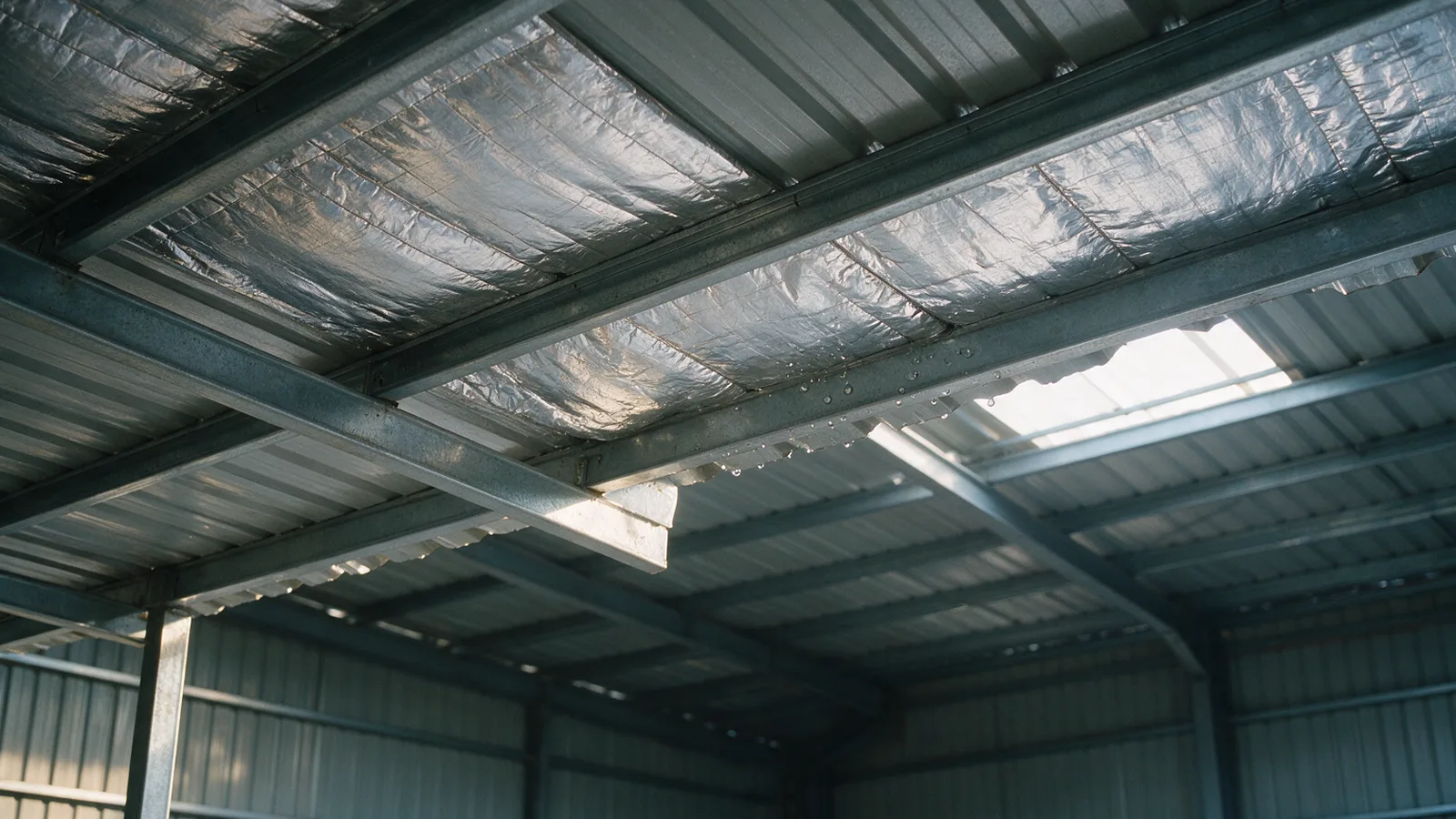
To stop condensation under a metal roof, vent moist air out of the building and keep warm, humid air away from the underside of the roof sheet with a vapour barrier. Lysaght's manual names reflective foil laminate as the common vapour barrier, draped between the roof supports so the cold sheet touches it only at the supports.
- Vent the water vapour out. The manual calls it "essential to vent substantial amounts of water vapour to outside the building."
- Add a vapour barrier under the roof sheet. "A vapour barrier is often used to prevent contact of warm moist air with the roofing - reflective foil laminate is commonly used."
- Drape the laminate between supports. The laminate "must be draped between roof supports so that the cold cladding is not in contact with the laminate (except at the supports)."
- Seal the joints. Where foil laminate is the vapour barrier, the joints are "overlapped about 100mm, and sealed with a tape impervious to moisture."
The same draped foil also helps with heat: the manual says that if the membrane drapes 50 to 75 mm between the supports, the air space "will further improve heat insulation." Our guide to choosing metal deck roofing covers the roof sheet itself.
Can new roof sheets suffer from condensation before they are fixed?
New roof sheets can be damaged by condensation before they are fixed, if they are stored wet in a stack. Lysaght's manual warns that rain or condensation is easily drawn between the surfaces of stacked sheets by capillary action, where it cannot evaporate easily and can cause deterioration of the coating.
The manual's advice is to keep the product dry and clear of the ground, and if stacked or bundled sheets become wet for extended periods, to "separate it, wipe it with a clean cloth and stack it to dry thoroughly." For how coating thickness is quoted on a roof sheet, see our guide to roof sheet thickness: BMT, TCT and APT.
Is it condensation or a roof leak?
Condensation and a roof leak can both drip from a metal roof, so it helps to note when the water appears and to have the roof checked before deciding which it is. Water from a leak comes in from outside; condensation forms on the underside of the sheet from the moist air inside the building.
A leak at a fixing often starts at a roofing screw; our guide to metal roof screws: how many, where and how tight explains how a screw should be set. If the problem is widespread, our guide to repairing or replacing a metal roof helps decide the next step. Ducero's work covers metal deck roofing, cladding and reroofing; send photos and the building's details through the contact page.
Frequently asked questions
Why is water dripping from the underside of my metal roof when it is not raining?
It may be condensation. Lysaght's installation manual explains that when the air in a building in contact with metal cladding is warmer than the cladding, water vapour in the air can condense on the inside of the cladding. Have the roof checked for leaks as well.
Does Malaysia's humidity make metal roof condensation more likely?
Malaysia's air carries a lot of moisture. MetMalaysia describes the climate as one of uniform temperature, high humidity and copious rainfall, with a maximum daily average humidity over 94 percent. Lysaght notes that the amount of condensation depends on the amount of water vapour in the air.
How do I stop condensation under a metal roof?
Lysaght's manual describes two measures: vent substantial amounts of water vapour to the outside, and use a vapour barrier, commonly reflective foil laminate, draped between the roof supports so the cold cladding does not touch it except at the supports.
Is condensation bad for insulation?
Yes. Lysaght's manual says that if insulation blankets or batts are wet, or even slightly dampened by condensation, their efficiency is reduced markedly. Condensation can also stain ceilings and walls.
Can stacked roof sheets be damaged by condensation before they are installed?
They can. Lysaght warns that rain or condensation is easily drawn between stacked sheets by capillary action, where it cannot evaporate easily and can damage the coating. Stack sheets clear of the ground and keep them dry.
How do I ask Ducero about a roof with condensation problems?
Ducero's work covers metal deck roofing, cladding, reroofing and light-gauge steel roof trusses. Send the building's location, how it is used and photos of the problem through the contact page at ducero.com.my/contact-us.php, or call +603 3123 1348.